Tuesday, 21 February 2012

Han Han and social media sales

While explaining this phenomenon editor says that internet is a perfect tool to make money, but provided that you sell both a very non-conformistic and easy vision of life. You need to engage with an illusion of not taking too much time, you also need to provoke.

Forbes Poland in it's newest online issue mentions Han Han as one among 20 people that can change the world.

Han Han is a Chinese blogger that writes about sex, cars, food, life, lifestyle, fashion, whatever else people would like to read about. His blog registered at Chinese equivalent of Twitter (sina.com) had exceeded 460 mln registered readers.


While explaining this phenomenon editor says that internet is a perfect tool to make money, but provided that you sell both a very non-conformistic and easy vision of life. You need to engage with an illusion of not taking too much time, you also need to provoke.

Well I have to apologise to you My Dear Readers for being such a boring person who writes long posts in decent English, hopefully with not too many typos. I do solemnly swear to provoke you once a while with harsh opinions.

I also promise some posts about K-pop, fashion, Korean soap operas and other of sort. 

Han Han Dude may be found at Wikipedia to read about him more :)

Monday, 20 February 2012

Desperation

Am not sure if this one is going to sound nice. But recently I decided to give up political correctness. My friend Martyna was nominated to the Traveller of the Year Award Kolosy 2011 in Poland for her Asian experiences.

While reading her blog I discovered that Seoul transforms into a city with no soul. Hi Seoul! Soul of Asia! slogan says. But what does it mean to have soul. It means to secure and preserve the best of Asia, common sense tells.

I have already written about Seoul Mayor closing down street vendoring and moving these people to more and more less payable locations. This increases done by the new Mayor also.

Will Koreans ever understand that we are not coming there for artificial things?! Not for created on purpose artificial junk! Junk like Hanok houses pretending to be ancient and being in fact rebuilt from new pieces only recently?! European sophisticated shops like Zara in Coex Mall or touristy mass production in Insa Dong?!

I have asked many friends if they have old Hanbok ( traditional female dress) inherited from their grandmothers or great grandmothers. Guess what, noone has old Hanboks!

- Obsoyo! There was a war and we don't have them anymore. - this is the reply I hear often. War cannot destroy everything.
Even Brother Anthony from Sogang University, who is a genuine specialist in Korean culture, sent me off to some factory making modern "traditional" Hanboks, all very colorful and nice.


 Photo from wikipedia, free licence with attribution: http://flickr.com/photos/paulcanning/314925845/ 
Above: This is what is available everywhere, colorful, nice, modern touristy production. 

Problem is this is not genuine. I will give more space later to Korean traditional dress how it really looked not longer than 40 years ago. But here I will shortly say that 2% of society could afford these sweet colorful Hanboks. Does it make it "traditional" already? What about other groups, what about farmers? They had Hanboks too, but white/grey.

Dear Readers, I am in desparate need of white/grey farmers Hanbok! Dirty, old, but genuine!!!! If you know about anyone, anyone who may be a happy owner of some, please let me know!

If it comes to Nation Branding Korea rocks. It is only pity that instead of preserving truth they build up stories of how rich they had always been.

I am not saying that there is nothing genuine in Seoul. There are still street markets and shops with everything and nothing, ginseng, spices of the world, hand painters making art pieces on silk or rice paper, but it slowly slowly goes away melted in unified asian version of global consumerism.

Friday, 17 February 2012

Nation branding

I have already mentioned about Korean Nation Branding efforts and how they impress me. In more developed countries than Korea comprehensive nation advertising and public diplomacy took much longer time or is not that well organized.
******
This entry of the blog has been featured on Arirang TV in Today's Blog programm, Trend Zone.
Coastal Asia Unrevealed on Arirang TV
Please watch in Internet Explorer like all Korean sites. Forgive me my voice, it is not really top voice ever.
******


Part of it is Korean Wave which currently hits Japan, China and other Asian countries. Korean boysbands and girlsbands, so called K-pop music to which you may find links in the video corner is just an example. Korean dramas with Winter Sonata leading among them, singer BoA and many others.

This year Seoul was choosen as one of the must-visit cities by UNESCO as a result of long term action of the Metropolitan Government. Maybe it was this little creature, Haechi, which was designed as a Seoul brand based on a fictional good spirit, symbol of the city, which caused it? Who knows...

Whether Haechi himself had blessed the city with good spirits or not, he definately works as a brand developed back in 2008. Metropolitan government uses it as a symbol which helps promoting good businesses for tourists.

I was taken for a dessert to one of the restaurants in a Korean traditional house situated in a White Collar area, next to the COEX Intercontinental, the very site were G20 was held. The restaurant which name is Pulhyanggi serves all sorts of Korean food for very sophisticated set of clients who usually go there for business negotiations and incentives.

 Inside the Pulhyanggi...

Btw. did I mention that my favorite Korean food is a pancake with seafood which is called haemul pajeon and I can even make it myself?

And this is how restaurants are promoted with the city brand sign:
The Haechi drawing is based on the ancient creature I have already mentioned, which looks like this:
And Seoul area is full of them standing in all sorts of places, both very modern and traditional ones.

As a city Seoul tries to catch up with modernity but also save what is the best from it's ancient spirits. For this all sorts of different things are done, one of them is Cheonggye Stream near Gwanhamun Plaza, or Design Street near Toksugung Palace. There we may find interesting things like design chairs or sculptures as below:
All fitted in traditional historic environment.

Haechi is successful in promoting business as well. An idea which had not been followed by other cities so far as I know. As a brand Hi Seoul is shared by all sorts of small companies which are given support by Seoul Metropolitan Government. The partnership is perfect for both sides: the city promotes itself even better and business gets money and stable environment to grow.
Above is one of the example of the shared brand products. We visited the exhibition with the TV crew from Arirang and were given a gift set with very useful and very nice items including a pen with a flashlight which I use a lot right now.

Haechi itself is a legendary animal representing justice and integrity. The mythical creature distinguishes good from evil and was believed to bring fortune and luck and provide safety from disaster. The creature has been believed to serve as a guardian of Seoul for a long time.

At Gwanhamun Plaza the souvenir shop opened and the top sells are Haechi dolls in all sizes. I got myself the small one... maybe it will bring me the luck?

*******
Just as I shared with viewers of Arirang I will repeat here. Despite constant threat from the North Seoul flourishes. Korea flourishes. South Koreans take steps foreward, round the clock, like a circle in a spiral... strive and persist.

Special thanks to Yoon-mi Jung and her crew who assisted me for more than 6 hrs on a freezing Friday in Seoul driving me around the city wherever I wanted. Thank you for your hospitality and patience. I love Korea! Although it was pictured more than a year ago I still remember the day and am very happy it happened :)

_________________________
Links to explore:
http://english.seoul.go.kr/gtk/news/news_view.php?idx=7700
http://www.idwseoul.com/interdesignen/user/bizapp/link/link_01.asp?sBBS=0501

Thursday, 16 February 2012

Saemul Undong - Korea's Receipe for Rural Development

 ‘Unless the residents have a desire of self-help for the change of their life, even if they wait for 5000 years, there will be no change. If the village residents try to change their life now, even with little support of government, they will be able to change their life in 2-3 years’. Park Chung-Hee

Korea was ruined by Japanese colonization and inter-Korean war. In 1950s, the plight of Koreans was miserable  and the nation was extremely poor, with very little food to survive. Harsh winters added to their miseries and ‘food n shelter’ was first priority for all Koreans. Per capita income was $79 in 1960, while that of Pakistan was $91 during the same Year.  Koreans studied Pakistani 5-year plan system and adopted it in 1962. They started seeing the results in shape of industrial growth and development of cities, but the rural areas were still lagging far behind.

Koreans soon realized that sustainable growth cannot be achieved without rural development. The standard of life in the villages was very low, with only 20% of the villages having electricity and only 20 % houses having roof.  Roads, infrastructure, tools and equipment for farming were missing altogether.  The only positive thing was that literacy rate was good and mandatory military service for all men above 18 produced a disciplined workforce.

In 1970, Saemul Undong (New Village Movement) was launched, aiming at improving the life of villagers. The idea was to pave the gap between rural and urban life, improving the living standard in rural areas and increasing the opportunities for the villagers to earn more. 

 The idea was to stop migration to cities. ‘A better village to live in’ was the goal of the movement.  The underlying spirit was to work with diligence, as the ‘early bird catches the worm’, there is no freebie in the world, so make an effort to achieve what you want.  The spirit of cooperation was also very important, as one cannot wash their face with one finger.

Government started with SMU in a unique way. They asked the villagers to participate in the program on self-help basis.  Three principles of ‘diligence, self help and cooperation’ were decided to be the basis of the movement. When the movement started, government was not in a very good financial situation, so they asked for the cooperation of residents of villages.  It provided 335 packs of cement to each of 33,267 villages in the country. Government suggested ten projects such as making roads, reforming roofs of homes, constructing public wells, making small water reservoirs and small bridges etc .Villagers had to decide one of the projects and then implement it.  They had to arrange the material such as sand and pebbles themselves, and had to work together to execute the project.  They had to select Seamaul leaders for themselves, who were volunteers, and would play the role of coordinators and arbitrators.

After one year of evaluation, the success ratio was about 50% .The performance of 16,600 villages was good, and they had completed their first task.  It was a turning point, the government decided to generate competition. They gave 500 sacks of cement and one ton steel to only these 16,600 villages, which were able to complete their first task, while remaining villages were told to do something with self-help and then government will decide accordingly.

This produced amazing results; a lot of villages improved very quickly, and more and more were joining the movement actively.  Based on this, government classified the villages into three categories according to their progress, and supported the outstanding villages more, which generated high competition.
The government established central council for the movement, to analyze and evaluate the performance. A training center was instituted to train the leaders elected by villagers. This helped in development of leadership at grass root level.  Women and youth were given equal participation, each village selecting a a leader, woman leader and young leader for the project. These voluntary leaders helped the government to plan, cooridnate and carry out the projects in a proper manner.

New projects were considered on the basis of their benefits to the entire community. The government did not interfere directly into the selection of projects. It was just overseeing the technical aspects and providing help with which the villagers couldn’t do themselves.

Soon they realized that without improving the income of villagers, their life could not be improved, so the next step was to improve the income level of villagers and eliminate poverty. Projects were focused to improve roads to the farms so that tractors and other machinery could be used in farming. Farmers were provided with basic tools and were trained for the better productivity. Irrigation system was improved and small water reservoirs were built to preserve water. Also green houses were developed to do farming in winters.  Investments were done in live-stocks and villagers were encouraged to grow live-stock for better income.
Agricultural complexes were made for profitable products such as mushrooms and tobacco, which helped to increase over all income.  Greenhouses allowed farmers to harvest during harsh winter season. Fishing villages changed their production methods from fishing to breeding fish. All of this improved the income level of villagers. As a result, agriculture household income was more than that of city workers. After only four years, the rural community household income was $674, more than that of urban household income of $644. This economic growth led to subjugate poverty and brought revolution in the mindset of people.

Residents were given the sense of ownership and they were the direct beneficiaries.  During initial stage, the focus was on improvement of thatched houses, heating system inside homes and agriculture roads. Then the focus shifted to more infra-structure reforms.  Electricity and water supply, agriculture machinery, irrigation system, all were aimed to improve the life of villagers with their involvement. The concepts of hard-work and self-help were embedded in this whole movement.
 

Due to proper evaluation system, government soon realized the mistakes of the movement.  Villagers lacked technical skills to build bridges and roads.  So government provided technical support and training required for the projects.

Grass root level leadership evolved as a reason of this movement, which lead to the development of Korea on many fronts. Corruption wasn’t a problem in this project, as population was involved in it, and the residents carried out the projects themselves. They also contributed financially to the extent they were able to do. The collective participation brought in transparency and better utilization of resources. The change went from rural to urban areas of Korea, whereas it is usually the other way around.

Korea today has become one of the top growing economies in the world, with national income of $ 20,014 per capita, (remember in 1960, Korea was at $79, and Pakistan was $91).  This is despite the fact that Korea has no natural resources, and it relies only on its human resource.  It is now one of the most advanced countries in internet usage, banking system and industrialized nation.

About ten Pakistani students (Masters/PhD researchers) attended this workshop. All of us had a consensus that this model cannot be copied directly considering our culture and traditions.  Our villages are usually big, and we lack consensus on leadership and projects. We are heavily divided and our women don’t work usually as labour workforce in building the bridges and widening the roads. So we need to make certain changes in this model and in our society too, for our growth and development.

In Pakistan, ‘actions must speak louder than words’, so the projects must be aimed at ‘doing more-talking less’ spirit.  The basic element in these projects should be consistency and continuity, learning from past experiences and improving with time. We can learn from these experiences as we are a resource rich country. We don’t have the problem of poverty similar to that of Koreans, our infra structure is not very up to the mark, but we do have something to build upon, so we don’t have to start from zero.

All we need is to participate on community basis, helping ourselves, and taking bold initiatives. When this movement started in Korea, a lot of people criticized it, but government continued persuading villagers to take part in the development process, and it yielded results. The evaluation of projects was step-wise and better performing villages were rewarded on the basis of merit. This helped a great deal in raising awareness and competition level.


Saemaul Movement members hold a briefing session with locals in Tanzania, to explain the concept and meaning of the Saemaul Undong

Korea has started to implement this project in African countries. While other countries prefer to perform charity work, Koreans are trying to engage villagers by asking them to contribute equally.  For instance, the project of establishing a goat bank is very good idea. Villagers are given goats, to raise, and when they breed more goats, the original ones are returned, thus establishing a live-stock bank.

Most important notion to learn is the reforms of the mind-set, to ‘we can do it’. Starting by simple, small projects, doing something tangible, will lead to something better and bigger eventually. We think of big projects first, but sometimes we need to think ‘small’ and ‘in the box’.  Making  roofs for homes, kitchens in houses, toilets, small water reservoirs, improving sanitary conditions,  building small bridges, improving water supply and sewerage systems- eventually the change will be getting bigger and visible which will help in improving the living standards.

Another point to focus is to increase the income of villagers, to stop urbanization. We believe in giving alms and charity,  but instead we should focus more on trying to make poor people earn more money. Increasing their income will change their mentality. As I mentioned earlier, Saemaul Undong wasn’t focusing on education and public health in the start, because people were mostly concerned about food and shelter, but as the movement went on to bring the change, people started thinking about education, health, learning opportunities and community life. Koreans did that successfully and now their rural life has almost all the facilities of their urban life so more and more people are preferring rural life.

In short, collaborative efforts will bring change, and rural development is the key to sustainable development even in the industrialized nations. Following are the words of President Park Chung Hee,
‘Unless the residents have a desire of self-help for the change of their life, even if they wait for 5000 years, there will be no change. If the village residents try to change their life now, even with little support of government, they will be able to change their life in 2-3 years’.
These simple words underline the spirit of the movement. No one will bring change for you, if you don’t want it yourself. And small consistent changes, will lead to a big and visible transformation. More importantly, ‘ do more, talk less’.

*******
Courtesy Muhammad Saad Khan mybirforchange.org 

Tuesday, 14 February 2012

V Day wishes

This time universal, not about Korea only :) 
Anthropologist Fisher breaks love into three distinct brain systems that enable mating and reproduction:

    Sex drive
    Romantic love (obsession, passion, infatuation)
    Attachment (calmness and security with a long-term partner)

These are brain systems, Fisher said, and all three play a role in love. They can operate independently, but people crave all three for an ideal relationship.

Which is why we feel rather calmness with lifetime partner and we women secretly desire Domogarov to kiss us instead some decent boring but stable sort of chap. On the contrary what Dr Kulesza from Warsaw School of Social Sciences and Humanities says, men clinge to peace of mind and do not tend to associate biggest passions and desires with lifetime partner.
But I am not sure if this applies to Slavic people. For some, maybe most of us passion is love and love is passion. Maybe we give it up for the sense of boring security or for social expectations, but for some reason women leave comments under this song:  Na krayu sveta/ The end of the world "oh how he kisses etc".

Don't divide life into your grey everydayness and fairy tales you think you cannot have. Go for your own fairy tale. Go through fire for what you believe in until you find it. Sometimes it is worth to go against the current.
Until you find all in one. 

And... don't apply too much science to it. Follow your heart.

With best wishes for V Day to all my friends from all corners of the world.

With love to those who are and always be important in my life.

Aga

Monday, 13 February 2012

Places to visit in Seoul

Seoul. Soul of Asia, the city slogan says.  Hi Seoul says the city brand. Bit of a guide what to visit once getting there.

I was recently asked for advice as to what to visit in Seoul if you are there for relatively short time.
This is indeed tough task to choose. So I will give a glympse on a few places that one may get to easily spending one day in Seoul.

If one had only one day it is better to start your day early.. Go to Gyeongbokgung station line 3 and take the palace exit. You will end up in front of the Palace Main gate. If you are there at 10 am you can experience a re-enactment of Korean military tradition - the Royal Guard Changing Ceremony - at the Gyeongbokgung Palace in Seoul. Palace gate guardsmen in traditional costumes end their sentry duty, present arms and parade.

My advice, don't buy the entrance ticket to the Palace, you will have better view standing somewhere in the courtyard. The show is not active on tuesdays.


Once you had seen the show you may proceed by walk towards the Kings statue that is not far away from the main gate.
Above is the King's Statue. He was one very smart person that invented one of the easiest ever written codes that can be for Asian language. Had troubles learning Chinese or Japanese? Korean is a piece of cake.


Since you already saw the King's Statue it would be nice to see some Temple and have a glympse of how they look inside and the feel of buddist calmness on your own.

For this you may pick any Temple that is situated in Seoul, the one situated near Insa Dong will do really great. When you enter the Temple remember to take off your shoes and remain totally silent. Switch your mobile sounds off just like you do in the church or a mosque. Inside you may do what others do, but it is better to just sit in the lotus position on the floor and simply take a reacess. A break from everything. Let your thoughts fly as they want, don't control anything. Meditate. 10' is enough and you will feel really great.

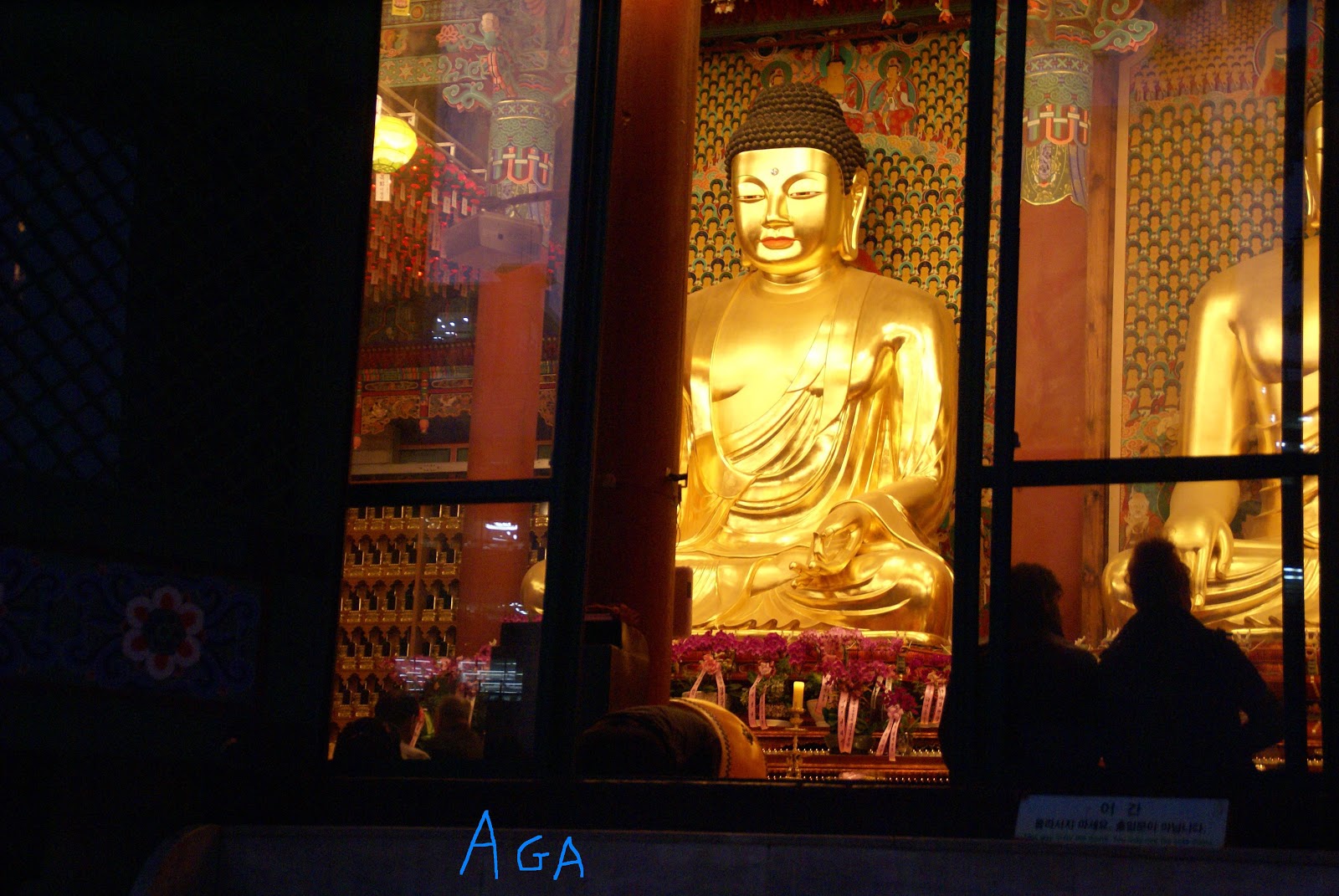
Buddha at Insa Dong. Normally it is not allowed to take a photo with DSLR but I broke a few rules. If I'd obeyed all the rules I would never have most of these photos anyway.


It's time for lunch. For lunch it is good to try some Korean Food. For a foreigner that is not accustomed to a lot of spices I recommend haemul pajeon for the beginning, which is a pancake with veggies and seafood. Good places for it are situated in the back alleys from Insa Dong main street. Also you may have a jamchi bibimpap which is a veggies mix with rice and tuna ( delicious).

To get to Insa Dong either go by subway to Anguk station line 3 or walk there on the left from Gyengbokgung main gate if you face the Gwanhammun.

As yoy see Insa Dong is also popular touristy stuff shopping mall. But in Korea it is very difficult to get something for genuine treasure hunters, and some things from there will be valuable souvenirs still.
Scroll paintings and celadon tea sets are those I would recommend the most. If you are rich you may try to get Korean traditional dress- hanbok - for yourself.

What to do with the rest of the time? Assume it is 2 pm and you have still some hours left.
You may visit Dongdaemun area for multicultural Seoul taste, this is where a lot of people from Central Asia and Russia live and run small restaurants or shops.

You may also go to Gangnam area to check whether the underground shopping mall is open. This is the place where you will enjoy traditional negotiations about the price of a product. However this does not apply for ladies shoes that are usually always discounted and available in all sorts of sizes and colors ( but sizes are mostly small).
Gangnam area.
Shops with shoes that are approximately everywhere.

For cheap shopping and street markets I recommend Nakseongdae/ Sadang area, there are a lot of shops in the neighborhood where a lot of different things can be purchased. These two are by the line 2. This is where you can buy ginseng roots and real seaweed ( not like the one at the airport). Seaweed is something I miss very much in poland and if someone brings me it I will be happy lol :P


Nakseongdae Street Market


You have probably realised I give guidelines how to originally spend your day. But if you prefer to go to the Museum you should visit the War Memorial by the Samgakji Station line 4 or 6. It is a short walk from exits 11 and 12, the cost 3000KRW per adult.

In the evening city looks nice from Namsan Tower which is visible from almost everywhere.
You can get there by a walk from exit 3 on Myeongdong station by line 4.
The link to a photo is here:
Seoul by night

Costs:
Food varies from 3000 KRW snacks at street vendors to 30 000 KRW circa at more sophisticated places.
Subway card is 5000, and 15 000 KRW should be enough to go around the city for the whole day.
Tea pottery varies from pieces by 1000 KRW up till sets of 150 000 KRW.
Scroll paintings vary from 10 000 KRW to 60 - 100 000 KRW.

Getting there:


 If you are at the airport, you may get taxi. But you will pay a lot.
Buses are better and you only need to ask which one to take.

 Bear in mind your phone won't work there, so for a cheap stay use rental service available at the airport.
Welcome to Korea! Enjoy your stay ! :):):)

Saturday, 11 February 2012

Kim Jung Un Dead or alive?

Kim Jung Un has been told assasinated a day ago during his visit to Beijing.  As much as it may be a calculated hoax it still might be truth though. But such jokes in our modern world have real impact.
 Let's assume Steve Jobs has got a flue 10 years ago. It was actually a real event when flu of genius Apple brain caused huge stocks collapse overnight. No, what do I say, overhour.

Every power that has no nuclear or military potential to harm South Korea or is being checkmated by its allies can still do a web attack or for instance spread a false rumour about young "crown prince" from the North dead.

When Kim Jong Il died last year the event caused huge losses in korean stocks which started correction only in late December / January. It may easily happen this time too, even if the rumour is false. This is also an occasion to earn on forex if I am right.

It always made me curious how in so scientific and mathematical environment as cash and investing haste decisions and psychology of the crowds always took over. At first 30% and some more stocks in Korea are owed by foreigners. If there is any news that situation in the country becomes unstable foreigners get cold feet, at least financially. Second issue is more complex and is related to following the crowd like a blind idiot. If a dude that sits next to me removes I shall also sell and this way index goes down. Usually time shows that what was needed was a bit of patience and individualism. Traits which humanity lacks as such and always will.

***********
Lol :P From my point of views it is cool to observe masses of people wondering, journalists racing to get the news first etc.

And you, how do you think, is he dead or is he alive?
Who may assasinate the guy? For what?

Sunday, 22 January 2012

Happy Sollal Everyone !!!!!

Guys I wish you a very very Happy new Lunar Year :)
All the best :) See you soon with new posts :)

Wednesday, 21 December 2011

The Hermit Kingdom

Kim Jong-un, the heir-apparent and son of Kim Jong-il, issued his first military order just before the announcement of his father's death this week, which some sources claim is the proof of young Kim's control over the military. 


Photo by AP


The North's state media reported Kim Jong-il's death Monday, two days after it occurred.  Before the the news of passing was announced, Kim Jong-un ordered all military units to stop field exercises and training and return to their bases.

"This is a direct example showing Kim Jong-un's complete control over the military," the source said, adding the move also indicated that the younger Kim is poised to become the top commander of the North's 1.1 million-strong military.

And so on... 


Above paragraphs are based on newest Korea Times articles about prospective difficulties of Kim Jung Un to seize power. Literally everyone around the world expects it. 


If I was to guess and make a bet, I bet there won't be bigger problem with power transfer than it usually is in any hereditary system with several wings of power. Normally parents of the heir have to buy loyalty of those who could try to destroy their plans. If the loyalty cannot be bought with priviledges, then opponents have to be removed anyhow else. 


Such game is ahead of Kim Jung Un. My bet is there is already a dynasty of Kims in an Hermit Kingdom. 


If nothing surprising happens this will just go on. Unless there is a military coup d'etat and the military modernizes country. But I would not bet on it.

And what do you think?

Monday, 19 December 2011

Kim Jong-Il Dies- what comes next

Kim Jong-Il died of a heart attack on December 17th  while travelling on the train. For two days, North Korea rulers kept this information secret from the state news agency, the Ministry of Foreign Affairs and the Ministry of Trade. Today, the news of the death of Dear Leader went around the whole world and made global breaking news.


Apart from the usual diplomatic messages expressing grief towards North Korea, the White House responded immediately to a message declaring that it is ready to support South Korea against potential changes in the situation on the Korean peninsula. President of South Korea raised the threat level of a cyber attack to Grade 3, the highest. South Korean authorities may, in fact, fear of attacks on their networks and servers, because this year several of them happened. The most serious attack occurred in July 2011, when hackers paralyzed SK Communications, a South Korean telecom company. The North korea was accused of attack which Pyeongyang never acknowledged.
Lee Myeong-bak also contacted the White House indicating his readiness to take all necessary steps required in that situation.


T
the financial markets reacted immediately to the death of Kim Jong-il. South Korea's Kospi index initially fell by 4.1 percent, but then regained a bit of loss and early morning, the decrease was 3.1 percent. Japanese Nikkei has lost 1 percent. and reached 8,314.44 points. According to Victor Cha from Center of Strategic and International Studies this is a reaction similar to the stock market declines in 1994 after the death of former North Korean dictator Kim Il-Sung.

Global speculations began about the transfer of power in North Korea. Some analysts expect turbulence and potential conflict between several wings of power in North Korea, including a military coup. Director of the Institute of International Relations, Yonsei University, Professor Lee Chung-Min claims we do not yet know all the answers to many questions. Seizure of power by Kim Jung-Un who was promoted to be the next leader by deceased Kim Jong-il depends on whether he will cope with the hardline generals who are willing to use the situation to take over strings in Pyeongyang. Before Kim Jung-Un will be able to implement any of his own ideas in North Korean politics he has to consolidate power and convince the reluctant ones.


South Koreans, who are closest to all events, react calmly. There is no widespread panic, no one collects goods in case of crisis. As I wrote earlier crisis in relations with North Korea occurs so often that South Koreans are accustomed to it., even if it is the death of the leader of North Korea. Lee Yong Jun, a young engineer from Suwon says it's too early to predict what will happen - It can lead to conflict for power, as hardliners are able to use a young age of Kim Jung-Un against him. But any discussion and figuring out is in my opinion, premature. None of the analysts really knows what will happen and their panic can only reflect on our wallets more than the potential movements of North Korea. - Yong Jun highlights.


This confirms the reaction of the Ministry of Defence, which remains calm and says that there is no compelling reason to raise the DEFCON alert of South Korean armed forces. Anti North Korean surveillance alert had also not been raised. South Korean President Lee Myeong-bak canceled all his meetings and called up an extraordinary summit designed to establish rules of conduct in the situation, however pressing the need for reason and calm. 


**********
Ironically we can guess whether this was a good or not good gift for President Lee-Myeong-bak's birthday which is exactly today. Photo: REUTERS

Sunday, 18 December 2011

Park Geun-hye used again?

"Park's role will likely begin and end as a kind of shield against cold drafts for the nominee review committee," the adviser from the Park wing predicted 2 days ago. 


Recently I had written that in future conservative figures compromised with old system of kinship, connections and silver spoon will less likely be choosen in the elections as the profile of voters and their values change.

In October mayoral elections in Seoul began a star of an independent politician who had no previous connections to any political party involved in traditional Korean politics. It may be one reason why GNP decided to reach for a legend of Park Chung-hee and allowed his daughter to come forefront and lead Hannara once again in her career. But another reason may be that Park Geun-hye if unbounded with any difficult responsibilities just before the presidential elections might focus all her resources on winning and becoming the Korea's next president.. Now one false step may be used against her both by the opposition and her own conservative collegues.

But Park Geun-hye is still unknown card in a tile. It is difficult to predict what she shall do as a leader, more than just doing PR in which she is perfect (see the previeus article on Park Geun-hye). She seems to have her own visions on looking for middle way in foreign affairs and domestic politics. But her chances for applying radical social reforms whiloe representing conservatives are rather slim, with that she would be better trying her chances with the socialist opposition.

Yet, the opposition does not want her. Her own pack may not want to listen. Possibly again she will be used as a shield and PR machine, not much more.

Wednesday, 14 December 2011

Talmud in Korea

Korea is by far the only country in the world outside of Israel, where Talmud is among mandatory textbooks for kids in school.
One person who laid a vital foundation to friendly connections between Korea and Israel is a Polish Jew saved from Holocaust who now lives in Israel and is a professor of Korean Studies at the Hebrew University in Jerusalem.

photo by:  huji.ac.il

Dr Jaakow Cohen was rewarded for his lifetime efforts with the highest recognition in Korean science- Order of Magnolia - which he received from the president of South Korea, Lee Myeong-bak on December 7th.

Now Talmud called in Korean 탈무드 is appreciated by Korean parents as a great way to develop critical thinking. It also promotes value of education and family ties, both very important in korea.


On the sidenote: author of this blog - me - had personally met a very serious Korean who is a PhD in physics from Oxford University, and claims as seriously as he is himself, that Koreans are the lost tribe of Israel.

Funny as it sounds, miracles happen. Such claims can be easily confirmed by genetics, and they sometimes are. There are native Africans, whose skin is undoubtedly black, who are genetically Jewish, and this was confirmed by chance during genographic project. So...

Saturday, 22 October 2011

Korean lady won International Violin Competition

Soyoung Yoon received 30 thousand € as a main prize in 14th International Henryk Wieniawski Violin Competition.
 Soyoung Yoon, winner. Photo from www.wieniawski.com

Second Prize got also an Asian- Miki Kobayashi from Japan, and Third wento to Stefan Tarara from Germany.

International Henryk Wieniawski Violin Competition is the oldest and most prestigious of it's kind in the world.For the first time it was organized in 1935 and since then it is held every 5 years, always in Poland.

Jury leader, Maxim Vengerov allowed 46 competitors to the first phase of competition, 6 of whom qualified to the final phase. Before that he made personal individual rehearsals of 120 of them travelling around the world to Yokohama, Seoul, Quebec, Bergamo, Moscow, Brussels, London, Baku and Poznań.

Soyoung Yoon admitted after receiving First Prize that it was the most important reward in her career by far. In the final phase she played Violin Concerto fis-moll op. 14 by Wieniawski and Violin Concerto d-moll op.47 by Sibellius.

To listen to Soyoung Yoon outstanding performance go to: http://www.wieniawski.com/yoon_so-young.html

Congratulations to the beautiful Korean lady :)

_____________

Sidenote: this is a perfect example of public diplomacy, neglected by professional diplomats for centuries and successfully done by world class artists.

Sunday, 2 October 2011

Korean Economy: end of the Golden Era?

Everyone wants to have a home. A place to stay where we secure a little bit of peace of mind and shelter from hostility of this world.

Such dreams are shared by at least two Korean generations who struggle to get to a good university, later struggle to get a good job and later get a mortgage loan to have a smaller or bigger apartment. After all, nothing bad in it, right?

Korean economy had been in a stable growth ever since President Park Chung-hee, with a small slowdown in 1997, when conglomerate welfare system had collapsed and huge reforms were ordered to be implemented by International Monetary Fund.

Recently Korean Won is getting weaker and weaker.  It already lost several hundred KRW in it's value year to year, however recently stopped losing.

But Korea is facing the very same fate as other countries do. Many countries in the world had believed that state investment can be endlessly covered by issuing bonds. USA believed that too, and foreign purchase of their bonds had more than doubled since early 1990's.  According to the Strategy and Finance Ministry Sunday, the country’s state debt is estimated to reach 448.2 trillion won, which is about $380 billion,  next year, up 25.5 trillion won from an estimated 422.7 trillion won in 2011.

The sad news for an average Korean is that about 222 trillion won of the government debt, accounting for 49.5 percent of the total, is to be repaid with taxpayer money, up from this year’s 48.5 percent to represent the highest level ever. The outstanding amount of government-guaranteed debt will likely reach a record high of 38 trillion won next year.


What an average citizen does not understand, is safe management of goods and income. Total amount of debts of all sorts cannot exceed 20% of monthly income of the household, otherwise if anything happens, they will be unpaid. Even in debt wise societies it is said that about 50% of mortgage loan holders won't be able to pay it after 15 years - half of a time of a loan. 

What is not helping, is an obsession to obtain higher degrees. The country does not need everyone to be a PhD for it's growth, it needs equal treatment of Bachelor's and Master's Degree holders. In average country everyone is needed, from a toilet keeper through a cleaning lady and bus driver up till an engineer. And not everyone needs to be educated like a professor of a university. 

I hope the best for Koreans, however I am afraid that we all have to reprioritise our lives globally. It is possible that there is no miracle ahead and unless new model of economy is implemented, nothing can be changed. 

In these circumstances it is an interesting question, who is a likely candidate to win presidential elections in upcoming year 2012. My next post will be about it, in about 3 weeks, as I go to a hospital now. 

Till then. 

Monday, 12 September 2011

Happy Chusok

Dear Korean friends, and readers from all over there in the internet.
I wish you a very Happy Chusok.

Saturday, 3 September 2011

Korean cooking: Songpyeon

Chusok is coming. I have written at least 2 times about how Korean people spend their Chusok. But here I will give a glympse on what they cook.

The video above shows a detailed receipe on how to prepare rice cakes which are eaten very often in Korea, but they are especially done during Chusok.


Recipe Ingredients:

  • 8 cups of rice flour (ssalgaru 쌀가루) this often is in the frozen section of a Korean grocery,
  • but if you are somewhere in the West go to your oriental shop and they will give you rice flower over there. More and more often network chains also have it, like Euroshop or Real. 
  • 2/3 tablespoons of salt
  • 1 cup of hot water
  • glug of sesame oil
  • Sesame seed stuffing
  • 1 cup of chamkae (roasted crushed sesame seed)
  • 2 tablespoons of honey - if you are in Eastern Europe, you are lucky, real honey is exactly what you have not far from your home, unlike anywhere else in the world
  • 14 tablespoons of salt
White bean stuffing - white bean paste can be served in variety of forms, but for this we need a sweet version:
  • 1 cup of white beans (navy beans)
  • 2 tablespoons of finely chopped walnuts
  • 2 tablespoons of honey
  • a pinch of salt

Recipe Steps:

  • For the white bean stuffing, soak the white beans for 1 hr or longer and boil until it gets very tender. Strain, then crush it with a potato masher. Strain again to remove any liquid. Mix the mashed white bean with walnuts, salt and honey. Set aside.
  • Make the sesame seed stuffing by crushing the roasted sesame seeds and mix with salt and honey. You can put this into a blender or food processor for a short burst. Set it aside.
  • Slowly pour 1 cup hot water into 8 cups of rice flour and knead to make a smooth dough. Now you're ready to stuff the dough.
  • Pull off a small piece (about 2 tablespoons) of the rice flour dough and roll it into a small ball. Push it down in the middle to make a small cave and put a teaspoonful of stuffing mix. Press down edges to close it, and make into a half-moon shape, or whichever shape you want to make it into. You can make half sesame seed stuff and half white bean stuffing.
  • When you're finished stuffing, get a steamer pot ready. Fill water to reach about the half of the pot and bring to a boil. Place a damp cheese cloth on the tray of the steamer, and place the stuffed rice balls on the tray. Steam for about 20 minutes. Turn off the heat and let it sit for five minutes.
  • Coat your hands with some sesame oil and then move each songpyeon (steamed rice balls) carefully to a serving dish. Serve warm or cold. It's best to eat songpyeon fresh. However, if you do have leftovers, you can store in the refrigerator (it will get hard). You'll need to resteam or microwave it to get it soft again.
Serving Size: 15
Preparation Time: 45 minutes

I will let you know how my rice cakes were soon :)


Thursday, 1 September 2011

Daegu Championships


World Championships in Athletics had started in Daegu, just a few days ago. They will last until Sunday.
While South Korea has been in the top 10 of the medal standings at the last two summer Olympics, winning 13 golds in Beijing, they have never won a medal of any color at a World Championships. 


The strategy is to focus on small number of disciplines but do them good, which makes bigger and bugger success over the years. This year the hosts focused on being among 10 top best national teams. 


Best or not, Koreans are happy to host the event, and are good at it. Also Daegu is a very beutiful city located in the middle of the country in the Geum River Valley enclypsed from the West by Nakdong. Also a city of thousands of trees and one of the greenest in Korea, which was the project realised in recent years to stop enormous overheating and smog in summer. I am not sure however if that has been stopped entirely by now - which maybe one of the reasons of reported headaches among athletes. 


Above on the photo, PaweÅ‚ Wojciechowski after beating world record in high jump, and also a record of Poland after nearly two decades. 


Sunday, 28 August 2011

World 2.0 tries to take over World 1.0

....which will win?
Have you ever wondered that times we all live in are really crazy? Our life is haste and  full of race for cash and pleasure, the faster the better. Our capability of waiting for something  is very limited. Everything we want to get fast, cash, career, women, relationships.

Several things made me think that there is a huge change to what some of us consider normal or good coming with the speed of light.

Let's assume that I have a headache and I am at work. More often I hear "Oh you should take a pill". Maybe one person out of 10 would actually move ass and give me a pill and some hot tea. Shocking right? You would think that action means more than words especially if someone calls himself a friend. Really?!!! I meet more and more people who say "you should". My comment on that: "I know sweedy what I should, but with this you can kiss my ass as far as I know. Piss off. Or move yourself and act, because what you usually get from me is action!". But this is 1.0 person talking to 2.0 one. It can be compared to trying to convince a cow in India to move away from the road.

Beeeeeeeeeeeeeeeeeeeeeep ************************** cenzorship

I was advised to cut off this part. :P

How many people of 1.0 do you know and how many of 2.0? Have you encountered more examples of the world getting crazy?

I would say I know them 50/50. But it is always easier to move the boundary further. To equalize all sorts of behavior. To stop calling things good or wrong. To stop having remorse for anything, or cut all social ties and substitute them with fake ones.

____________

This post was more general, not just about Korea. But I think that these issues touch all of us, globally.
Warm regards to all of my 1.0 friends and 1.0 other users out there.


Thursday, 25 August 2011

Form or content?

Higher Education in Korea is a very good example of social stratification. Not that Korea does not fight with inequalities, because numerous attempts are being done.

But this year, I have learnt that Seoul National University was turned into full private one. Most of Gangnam youngsters born with golden spoon in their mouth (if I am to cite my friend literally) voted for it.

It means that the tuition fee will significantly rise and so the door for smart people from less wealthy families will be closed, unless they get scholarship, or do some jobs for survival.Or something other than a "job" but what gives income.

Everyone in Korea beats to take seat at SNU, Korea Universyty or Yonsei, so called SKY. There is a notion that the top elite in the country are SKY graduates with easy path ahead in life.

In Korea however, the name matter more than the actual quality of education. Among lying challenges ahead is growing pressure for international majors made mostly in English. English language, very difficult for Koreans is used to explain matters which are enough complicated and difficult if taught in Korean.

Also big pressure for number of publications causes drop in it's quality, as not many of these poapers are cited by other scholars. Leydesdorff and Han mentioned about it in Scientometrics.

Young Koreans worry enough that they won't be able to pay for tuition fees and the situation when they do not pay for actual quality makes them frustrated even more. Professor Han, a physics scientist of Korean origin who works in USA, says that most of young Koreans did not posess basic skills of creative thinking and connecting facts when they entered PhD studies in USA.

Is the situation changing? I am not sure. Transformation of SNU into private entity is not a good sign. But I remember that I once met a girl who graduated from International Business at Ajou University in Suwon, and who was a successful investment banker at one of the better financial institutions. Being Ajou graduate, not at all top university in Korea, did not stop her from being successful.

Maybe there is some hope? I will get back to the aspects of Korean science in other posts too. Sorry for the long break.


Monday, 4 July 2011

Bin Laden and East Asia

...is South Korea ready for terror?


It is 3rd August 2009, I leave the plane which just landed heading from Amsterdam to Seoul Incheon airport. After a not very thorough check up I am already in the car with my Korean friend. A nice pretty Asian lady smiles to me here and there and asks if I need anything and if I am comforted enough.

South Korea is one of the safest countries in the world. It has a unique cultural system based on the respect for rules and for the elders, where certain grey moral zone stays hidden from mass sight, and an average citizen is rather happy and confident that neither he will do anything threatening to the society nor it shall be done to him.

Although culturally explained cases of corruption influence negatively business and are a challenge, you may be quite confident that once you leave your DSLR on subway or loose a wallet, your chances to get it back are nearly 100%. Not big chances for the same in Europe, right?

In a society that trusts eachother like this everyone is nice and open. People are friendly. But after G20 summit I attended last year there have been comments that Korea is not protected enough against terror attack, due to lack of thorough security, big amount of trust given to everyone and poor intelligence among communities which may be a bigger source of a threat.

Not that a danger of terror attack is big. Korea does it's best to do business with everyone and asks very limited number of questions. Is a very non-threatening and stabilizing power of growth in many corners of the world. So far this strategy works very well.

This year in Seoul there were 3 blasts, yet unconnected to global terror networks. A very "creative" ex-convict thought to earn cash on falling stocks if he triggers panic. He invested about $45 000 ( 50 mln KRW). He did not gain much and instead was very quickly arrested. Soth Korea, and especially Seoul, has one of the most efficient networks of municipal survelllence> Cameras are almost hidden from sight, they are installed on very high buildings, but their resolution  enables to take a clear facial snapshot of a suspect, or the plate numbers if needed. 

Applying more strict security measures in future is rather necessary if Korea wants to play global ( and it does). Sad fact is that it shall destroy one of the most wonderful aspects of this remarkable country, enormous hospitality and trust. Luckily so far Bin Ladens of this world leave Koreans alone. 

______________

The photo comes from securityinfowatch.com