Showing posts with label tourist important. Show all posts

Thursday, 27 January 2011

Winter Sonata. ''Romantic” trip to Chuncheon Part 2

In the morning we woke up later than planned. It was so quiet in the apartment of our host. Such quiet I have not experienced on the long run up till now. What was scary in the evening when we got here suddenly appeared to be so bright and full of sun.

That settlement had been 30 years old up till now as our host explained. Indeed he had what people in Korea hardly have any longer. Keys to his apartment. A set of small metal thingies which give a feeling of a real home.

This morning it was even colder. -23 according to weather forecast. We were laughing our cold off all the time. After all two women on the go is always lots of fun, once they start joking it never ends.


The plan for today was seeing islands on the lakes. Several of them had been also pictured in Winter Sonata. It had been a one chance in a million to see what Korean people consider romantic.

We headed towards Jungdo Island on the lake near city center. This time we had been from Europe and from India for the purpose of taxi driver curiosity. Freezing cold got even inside the cab. 15 minutes after leaving the apartment we could not feel our feet any longer. Ajoshi wasn't much talkative either. He had been watching tv on his car and probably cursed the fate of his job. Blue morning sky was totally clear, whiteness of the snow unreal for the city's vincinity, looked like taken straight from Queen of Snow fary tale. Would anyone through a piece of ice into my eye this day? Or would I meet someone who would melt it away?

On a ferry to Jungdo Island it seemed that only foreigners can be crazy enough to do any outdoor sightseeing in this weather. Just us and the captain of the floating device. A thought crossed my head, what if something happens to this boat in freezing cold like this. Sun reflected on the icy water. By this time Yukti was hungry but we were still stubbornly on the go. Weird are these foreigners.

        -   Call us 5' before you want to go back. - worried captain told us.
         Apparently he was not sure if we get lost on the island or not. It was the nicest ever approach in my life, private ferry services for not that expensive price of 5000KRW. We got off at the bank and we saw the island. Not a desert island though, a bunch of Koreans headed desparately to the ferry from the freezing cold outside. And us...headed exactly there.

We saw a plastic orange tent serving as a waiting room for a ferry. Somebody resourceful had also made a live fire in the metal barrel exactly like for homeless people somewhere around dark corners of NY or any other city. . In such circumstances the very fact that there is a roof waiting somewhere makes one happy. Very happy. Even if the aircon is noisy washrooms are not private and the nightwatch sees all of your actions.

After 200m of a walk Yukti asked:
-    Can you stand this?
-    No I can't Yukti, it's over. Let's get somewhere under the roof and try to figure out what's here.
-    Ok.

We got inside the local equivalent of something between a kiosk a convenience store and a restaurant. In the middle of it coal heater was settled under traditional huge pot boiling water for whatever reason. Ajoshi behind the counter merely glanced at us and got back to reading Chosun Ilpo. Frozen, we slowly let ourselves relax near the warmth. Feeling of desparation appeared on Yukti's face when we bought onion chips just not to annoy the owner of our shelter too much.

-    All this way from Suwon and we bought chips. We sit and we eat chips. This is something we can do at home.

Burst of sarcastic laugh on my side had put a period to this statement. No matter how motivated I am, -23 degrees is not a temperature for me to handle. My camera would also give up soon.

We headed for a walk towards the pension where they pictured Winter Sonata. It crossed my mind that I understand what is it what Korean public considers romantic. The camp site combined of some 30 small wooden cabins which can fit a family was situated at the lakeside. Away from the city noise, away from civilization. Remote, and underdeveloped for a Korean standard at least. In a country of constant homogenous constructions and no diversity such places can indeed be called romantic. They touch this gentle part of soul in a person.


-   Can you imagine walking hand in hand with a beloved one on crunching snow like this in freezing cold? - asked Yukti.
-   Yes Yukti, oh yes, I can.

Same thought apparently crossed our heads in the very same moment. Indeed, this would be nice.

Sarcastic humour left us soon as we headed to a homeless barrel. It had been surrounded by a lot of ajummas and girls on sightseeing. Finally we were not only two desperados. They shared with us whatever they had, it touched my heart not for the first time how they share whatever limited resources they have. These were some sticky cookies and pieces of baguette. Filled our stomaches for the time being. Because you are a guest and because you are welcome. Such is Korean heart. Such is the part of it which I genuinely love.

Back in downtown we asked for anything to eat and proud locals had recommended us Dalgalbi of course.

-   Apero hagu uenchok and you are there. Straight and on the left.

I looked ahead and thought that no, Dalgalbi can wait until I visit Chuncheon anytime in my life again. Maybe that time it will be different? Somehow, I don't remember when, we ended up at E-Mart because it was warm. Finally warm.

Such was the trip to a city of Chuncheon. It left me with the impression that what humans perceive as romantic is what touches the primeaval part of human consciousness which is connected to nature. It brings me up the words of Gary Snyder, converted buddhist and poet: ''Culture which cuts off from natural and wild life around us and which denies the wild life inside us drives to very dangerous phenomena which will probably destroy humanity one day”.

Chuncheon 16th January 2011

Thursday, 20 January 2011

Guinsa Temple Part 3

After short rest we headed on the routine. This was the time when I felt the power of writing a book about a country and it's people. Hyondok Sunim had brought us off the typical routine of bows and meditation but instead decided to show the space of work, whatever possible in that freezing cold Christmas Day. The sky was so blue on that day.

We were brought into the ladies work space. Like in CatholicChurch or any other traditional patriarchal system women take care for guys stuff, they make cloths, sew them, iron, wash, cook, whatever to deliver ready for the monks.


I was shown their work space where they prepare buddhist religious outfit. Several ladies where sitting in rather small room with the entrance straight from the cold. One of them was cutting pieces. Another one was steam ironing them so it would be easier to sew them. One of them was making trousers only, another one tops. It was visible that they like it. Their way of life, daily work routine. Among giggles and laughs they kept asking questions about our countries, religion, opinions. Every now and then they bursted with laugh after Sunim told stories on our difficult adjustment to the rythm of life in the temple.

An important holiday was approaching. For the celebration purposes, the entire Temple site had been decorated with lanterns which looked like chickens but supposed to be dragons. Temple itself is quite new and very nicely decorated in the mixture of patterns and fresquos with green, gold and red as dominant colors. People headed around us on their routine. Pilgrims arrived and departured. For them it is an equivalent of Lourdes or Fatima, or even Częstochowa. A pilgrimage place where quantities of people head for a moment of refreshment and try just to stop in their haste of life. Maybe pray for their children's successes, their lost love, maybe for better health?


What is strikingly common to see is the fact that Buddism as a religion is a female issue in Korea. There have been quantities of ajummas in a scope of age starting from 40 and up, crowded on narrow spaces and hardly any men present. Maybe 5 of them among hundreds of women? Common phenomenon for the whole world.

It reminds me of, what I thought was a nasty antifeministic comment at the time, words spoken by the local parish priest in Warsaw: "When a woman prays it's normal. A matter of fact. Her soul is emotional, tempts to mysticism. But when cold logic driven male brain prays it is precious. More valued than female prayer." I still remember how angry I was, but when I look at it, I must admit that it is so true. Men are stronger in driving for their goals, never blaim extra factors for their failures or successes and are hardly ever emotional. But this is what makes them successful, after all.

At the lunch time there was time for the  truth. Sleeping routine at the Temple was not for me. I cannot go to sleep at 8 pm for 2 hrs and later at 4:30 am for 2 hours. I was grey on my face and very very tired.

I will be back to Guinsa, Hyondok Sunim. Maybe I will be more tough?

The last part of the day was tea ceremony with a monk. He could not speak english, but I think he understood. He had driven our attention to the fact that Avatar movie had a lot of buddhist elements in it. My journalist self overcame a diplomat inside me when I asked:

- How is buddism related to Korean mindset and modern development? You said that everything is interconnected and hence we should be responsible for nature. But in this case why are Korean people so detached from it? Temple Sites are protected because it is cultural heritage, but if there is no cultural heritage but there is a mount which is home to rare species, it would be blown up with no hesitation? Centuries of buddhist belief did not leave a trace in Korean mindset?

Sunim, an ex journalist, responded:

- I am not smart enough to speak about politics.

Hmm. Indead. That was not a political question I think...

- But maybe he is? - and I show our host. The response from the monk in translation was:

- There are challenges in modern world, but you need to practise. If you practise it will be allright.
 If you practise it will be allright...

Perfect solution which every religion makes for a believer. But maybe there is something in it?

I must admit that the meditation in the small Dharma Hall brought me peace of mind which I had not experienced in more than a month before Christmas. Despite on the faith and religion, or lack of it, if you stop and ask yourself: Quo Vadis? Quo Vadis Humanae? Where do you go? Who are you? What are your dreams? What are your sins? What makes the sense of your life? it is more than beneficial. Guinsa Temple had given me that.

On the icy cold evening with snow crunching under our feet and millions of stars on the sky we headed home. There are no stars in Seoul. Lights of civilization had taken over too long ago.

Hyondok Sunim, I will be back one day.

Guinsa Temple, Christmas 2010

Sunday, 16 January 2011

"Romantic" City of Chuncheon Part 1

 - Ah, so you can't have coffee with me because you go to Chuncheon. Right. Make sure you take lots of cloths because it will be very cold. Have fun. - my good Russian friend stated philosophically. 

I never care much for weather forecast in Korea, because it is hardly reliable and because in winter supposed to be cold. Frost, snow and blue sky are what makes a good winter.

Sometimes it makes that winter too good. We met at 9 am on a very chilly Saturday morning and bought tickets to Chuncheon which is north-east from Seoul area. The bus was warm and comfortably brought us to the destination, however on the way we passed a lot of smaller and bigger places which the further we went the more they looked like some middle of nowhere. 

 More and more in the middle of nowhere...

After getting off the bus we headed to downtown area which for some reason is called Myeong-Dong. Taxi driver, very happy for the given weather conditions smiled at us and asks:

-  Juoyo? Cold?

-   Aju juoyo... after that Yukti says something I could not understand quite well. Taxi drivers have two different favorite sports here. If I go on taxi with a girl, they ask where we are from and they usually start from guessing that we are from USA.

-  Where are you from?
-  France. - says Yukti with a joking spark in her eyes – and she is from USA.


Our ajoshi seemed to be more than happy that I was from USA and Yukti was from France for the purpose of this short ride to the city center. Another favorite hobby they have is asking a man in the cab if I am his wife or not and if he is going to kiss me or not. This is at least as much as I understood once when I was with a guy on the cab in the evening. But this time I was with Yukti, my amazing Indian friend who always smiles and the hobby version was much less annoying.

Once in downtown we had seen that the center was called Myeong-Dong for a reason. It apparently attempted to be a copy of Myeong-Dong in Seoul even with Myeong-Dong shoes for a tourist who would go to this city for shoes.

Well, we got here for sightseeing, not for shoes. Myeong-Dong shoes can wait, they are available in Seoul. Or not? Maybe not? 


Soon after however we got to the street marked with a very nice chicken on it's pavement. It was Dalgalbi street. We wanted to eat at last and try something new.

One of the attractions in ''romantic city of Chuncheon” is the local food, Dalgalbi. It is chicken on the grill with cabbage and tok – rice cake. However every restaurant was so full that we thought it must be some festival going on. The only empty one happened to be a place reserved for bigger groups. At last we just got to any given restaurant.

Dalgalbi was very nice but very spicy ( yes, I learnt to like spicy food!).
Even Yukti despite being a vegatarian had a bit of Dalgalbi. While we were assisted by a very helpful and elegant ajumma, some ajoshi hooked us asking Korean favorite question:

-  Where are you from?

After few introductions he admitted that he knows parts of India quite well and that he had been to Warsaw. We were very impressed by the gentleman's language skills, the conversation went on smoothly with him repeating every now and then who he is what had he done so far and how is he smart. And that he knows India and Poland and traveled in business there, of which he seemed to be very proud. He seemed to be proud of himself too. But wait, is this just Korean or is it simply male?

His daughter, a fresh lancet beauty, knew him obviously better than us and said:

-  Never mind him, he likes to know everything best.

Culturally shocking attitude here. I have seen some young boys carrying around their girls' handbags after they watched some soap operas, but I had not seen a daughter to be so equal in relations to any father here in Korea so far. Later we learnt that the man works for Hyundai and this is the reason why he knew our countries quite well before. As a modern Korean financial aristocrat seems to be excused from cultural norms and does not care for them much. He, his daughter and her boyfriend had seated for a sophisticated Dalgalbi luncheon on my 1.


-   Look at these individuals over there. - said Yukti.

Meanwhile on my 3 I had a nice picture of guys with black uniforms, longer hair in pony tails, 3 out of whom looked apparently Japanese. They had something on their necks which looked like rosary with a small penis attached. My neighbors looked at us every now and then and I kept looking at them. One moment I was tempted too much and I asked for a photo permission. This is how I have a photo with this gentleman. Obviously I asked what this small penis meant.

- It is religious symbol for first son. First baby – ajumma politically corrected herself.
Was it a baby or was it a penis? I don't know yet. Nevertheless the individuals seemed to be just as interested in us as we had been in them. In the background crowd of people had been patiently waiting for their turn, others were eating and drinking, some were sitting normally, some on the heated floor. The Dalgalbi luncheon fiesta was at it's most! 

 Was it a baby or was it a penis? I don't know. Dalgalbi fiesta went on.

After lunch it was time to decide what to do. Sitting in Cold Stone we had studied a map. Our host whom I found on couchsurfing lived in the eastern part of the city, hence we decided to see what that area offered to us and cover the rest on Sunday.

Not for the first time it had been a real struggle to go out into -17 degrees outside. Blue sky was not helping much anymore. But, Dear Reader, it would be rather pathetic to end up eating only local food, wouldn't it?

Why -17 in Chuncheon? Time to answer this question now. It supposed to be my destination for Chusok, but hell, it wasn't. Don't ask me why, ask the sky. Part of it was weather.

-17 happens to be a number on the termometer outside of the window, and the red liquid inside does not wanna move any bit higher, no matter how hard I pray for that. Now I have time for travelling, so I need to stand merciless – 17.

Yes, but this is not an answer to the question, why was it my destination. Part of it is the city's size. It is small, compact, surrounded with the lakes, settled among mountains rising straight from the water, it is a misty resemblance of Norway to unfamiliar ones. Another reason is that they had pictured South Korean most famous drama here, Winter Sonata. I have not seen any piece of it, but I was curious which surroundings and views Koreans would consider especially good for a romance scenery. 

Therefore we headed to the famous Soyang Dam by the local bus. The ride had taken us very high above the water level. Sceneries were absolutely beautiful. Slightly blue mountains covered here and there with snow and the steel blue lake far down below us which water had not been frozen yet and a blue sky. Absolutely astonishing. 

 Steel blue waters of the lake, blue sky and freezing wind. Winter Sonata.

If it only wasn't so windy! Our ''romantic trip” to Winter Sonata site had started more than chilly and it was my very self who had done this to us. Apparently I have some masochistic traits.
The wind had taken away all our warmth. Resourceful Korean overcommercialized capitalists whom I curse so often this time had been so resourceful and placed a building on top of the dam. It was reasonably warm in there.

After visiting the dam we decided to see the Museum in Chuncheon, but as a nice lady in the tourist info said, it was closed as of today. Therefore we headed to the Ethiopian War Memorial.

-Yuk shi closed. - said the watchdog downstairs with apparent attempt to shut the door in front of our faces.

-  But it is 5:55 – said Yukti, who is more than resourceful when needed.
This was how we made it inside the memorial for the Ethiopian war efforts which also shows a lot of culture. Items presented inside are really taken from Ethiopia or inspired by it's ancient culture remembering King Salomon and Queen Saba. The fresquos on the roofs are worth a glympse. They feature Ethiopian early churches from 3rd and 4th Century A.D. and the daily life of the villagers. Some everyday usage items and other artifacts are on display. It was the quickest sightseeing in my life, in 10' we were done with the Memorial Hall.

It was dark. Temperature fell to 23 in the negative. Hardly ever I could feel my skin being slowly frozen, despite my thickest possible outfit. It happens when it is below -20. 
 Happy masochist who is the owner of this blog.

Nolens volens we went for the Ethiopian Espresso since we were next to this place. Inside the coffee house I had seen many artifacts taken from Africa which were very real, neither of them had been made in China.

We sat by the window slowly defreezing ourselves. We both knew it was enough for today. Last issue to solve was to find our host from couchsurfing. Before that however we enjoyed taste of real African coffee which I know so well. It won't be modest to admit it, but Ethiopian coffee is welcome on my table ever since I know Krzysztof, a fellow traveller, who married a girl from Ethiopia. Twice a year or so he arrives with huge quantities of coffee in Warsaw, some of which gets safely delivered to my address. 

 Sometimes we were only silent...

Among the aroma of the seeds we enjoyed conversation about common female topics, at moments only sitting quietly. Outside of the window moon reflected in the iced water which even from inside seemed to crunch and whisper. What did it want to tell...?

We were on the way out when the owner took a chance to explain us the history of his coffee house. A word ''book” worked magic again. Jung Dae Cha is a second generation of owners who manages this coffee business. He says that it is the oldest coffee house in the entire South Korea. It started as soon as the Emperor of Ethiopia, Haile Selassie visited Chuncheon in 1968 and had put his tent in the very spot where the coffee house is. The Memorial was opened to keep the memory of Ethiopian troops who participated bravely in the bloody times of Korean Civil War.

One hour later we finally reached the destination. Our host welcomed us with his warm house. Himself being very sick made this effort despite of any circumstances because commitment to a once given word matters. We spent the evening having interesting conversation about ancient medicine and Judaic belief.

Two hours later Yukti was sleeping and I was laying in total darkness wondering what the next day might bring...

To be continued...
Chuncheon, 15th January 2011


Saturday, 8 January 2011

Guinsa Temple Part 2

After the dinner we were located in the pilgrims praying room in one of the floors in the main Dharma Hall building Our sunim had brought cloths for praying and walking around the complex, so those of us who did not feel warm enough, had put them on. Well, in the Temple or not, I do not fancy wearing something which covers me too much so I had the pants on only for the night.

The hall was full of women singing louder or more quiet main mantra of the Temple...or sutra...Byang Seum Bo Sal and so on like this on and on and on again. They were sitting in the lotus position or not, but as 2, 3 day pilgrims some of them, especially children, had given up on their buddhist duties and gradually fell asleep. To be frank, I made it up to 1 am on the prayers. Later we tried to get a nap, just like other ladies around us.


At 03:20 sharp we were told to appear in front of Dharma Hall. As we went out of our hot sleeping/praying place I saw millions of stars. Total silence surrounded us. Tree tops glisened in the misty light of stars and snow crunched under our feet. We followed monks inside the Temple...in the middle of the night voices of the lama started...what did they sing, what did they speak that I don't know yet. Not for me to comprehend with my limited Korean skills. Not yet.

After the celebration we went out. Our name cards remained inside on our seats. Someone prayed for us. Maybe for fortune or maybe for wisdom. Insight into the right steps. Who knows.

It was then under the stars of the provinsial Korean sky when I realised what I am actually doing. Why am I here and not on a couch in Warsaw. Why am I always on the go.

When I was a kid I read stories of a writer who created my favorite book character, so alive that I still can see how he looks like in front of my eyes. He was a young guy with special curiosity about the world. With his father and friends travelled across the globe to gather animals for Hagenbeck Zoo in Berlin. In one of the stories he goes to Tibet via Himalaya to rescue a friend and in search of gold. Snowblinded ends up in Lhasa Temple where lamas in the buddhist-lamaistic shrine take care of him. Soon after he joins their daily routine out of curiosity....

And it was me Tomek or Tomek me who joined lamas on the morning walk with their praying rosaries in hands. It was me Tomek or Tomek me who walked around the temple. The bells and the gongs made it even more magic. Was it Tibet 100 years ago or was it Guinsa in 21st century? I no longer knew. I knew that I was born to do just the same. Travel. Experience. Gather reality around me and share it with people. If I ever cried with relief it was then.

In an hour we were back in our hot sleeping place. Ladies in trans did not disturb me any longer. I have regained my curiosity of who they are and why they do what they do.

I have regained curiosity of what they do and why they do it...

Breakfast had given an answer to my questions regarding sunim. She shared the story of her life with us at that time. Used to be a tv and radio journalist in her previous life and a catholic converted into a buddhist at some point in her path. Found her sense and the meaning in serving the community. She may wear grey jacket and modest uniform but her energy of a reporter is still there. Once we have it we have it forever. That was the reason why I felt connection and why I knew instantly we would stay in touch.

To be continued....

Sunday, 2 January 2011

Multi-culti Ansan City

...in other words just cool story.

The plan was to go to Oido just because there supposed to be a seaside over there.
But as I was at Sadang Station in Seoul, subway was heading for Ansan and the plan got naturally amended on the spot. Destination Ansan.

What is interesting in Ansan? People say that birdwatching is possible. Somewhere around the city scholars from SNU had even made a documentary about night birds, like owl. The documentary was shown on BBC a year ago.

Just as I got off at Ansan Station I immediately got involved into my favorite one: peoplewatching. Indeed spectrum of cultures and different faces is enormous. Languages spoken differ among mongolian, vietnamese, indonesian and others.


...so many different faces

All of them starred at me top-down screening with curiosity or some dirty thoughts in case of male. Indeed a European dressed in red hiking set is a rare view over there. These immigrant inhabitants of the city are not the richest obviously. Their skin is not radiant, eyes are tired. Some of them try to rest under thick blankets while trading something.

 ...they are tired

I didn't quit hopes to find that birdwatching site and was wondering among the streets until in some park I heard so common sound:

-Natasha! Natasha! Kuda Ty? Natasha, where are you? - some people looking like Asians were calling someone.

- Izvinite, Wy govorite pa angliyskiy? Do you speak english?
-Niet, ne horosho. Sorry, no.
- Mnie nada posmotriet' ptitsy, Wy znaete gde ya mogu naiti ptitsnyj rezervat? I want to find some birds for birdwatching, do you know where is it possible?
- I am sorry no. Wy gavarite po russkiy otschen' hortosho, Wy otkuda? Kakaya u Was yest kamyera? - a gentleman asked me about my camera, as apparently he was a photo freak as well. Also said that I speak russian well. I don't but nevertheless it was already another time my russian skills where very useful in Korea.

- Sony Alpha 100, eto gavno yest - I critisized my camera in non exactly most classy russian expression.
-Potshemu gavno? Moshna dyelat horosho. It's not that bad after all.- replied my new friend.

Eventually I learned that the gentleman was from Tashkent in Uzbekistan working in Korea. He kept asking where was I from.

- Ya iz Polshy. I come from Poland. - said I.
 ...cyrylic and hangul, happened every 500m

- Ach z Polski, w Uzbekistanie moim szefem był Polak. Back in Uzbekistan my boss was Polish.. We are both Koreans born there during Stalin times. Many Polish were also dragged by Stalin and this is how I learnt your language a little bit.

At this point I quit attempts to find birds and instead enjoyed people. Ended up having Polish-Korean-Uzbekh dinner and after I headed home.I must admit that I did not expect finding a Polish speaking Korean from Uzbekistan somewhere in Ansan which is not the biggest city at all.

Saturday, 1 January 2011

Guinsa Temple Part 1

This Christmas happened to be spent at Guinsa Temple, where I decided to go in the very aim to perform perpetual state of motion, hence go. 

When 3 people travel, their personalities differ and they have to compose a society in it's mini scope for a given number of days or hours. It is a perfect school of tolerance and friendship. 3 of us, Polish, German... and not Russian ( like would be in that joke from past) but Lithuanian on the go. Louisa, not the fastest person in the world, but one of the smartest, Svajune, haste on going and punctual, and me, rather quiet on the journey, prepared trekker, and taking a lot of brain shortcuts which can have consequences at times. And it had during our preparations when I didn't tell Svajune beforehand that we are actually supposed to be ready for survival in terms of dressing and equipment. But, nevertheless Svajune is tough and made it in her own outfit. And even made a profit out of it, but let the story go as it goes...


We got off the bus in Korean equivalent of the middle of nowhere. Something simmilar Wild Wild West city in US countryside where both high tech and total bronze age meets in one spot. The bus ticket booth being both the kiosk for whatever needed with the ajoshi inside who looked at us like on the aliens. Prepared to speak my limited Korean I asked: Guinsa odiye isoyo. He looked at me again with bored sight of a man who had seen so many people and faces that I don't matter at all and shown the direction up and right.

Darkness around and reflections of street lights sparkling on the icy pavement up. By that time I got questions if we are at the right place and if we shouldn't go back to the bigger city and remarks that adventures in negative temperatures are not the best solution. Ignored them all: - Go. - said I. And headed upwards in the night full of stars.

I wish it was a longer walk. Surprisingly close I saw the complex of traditional roofs and new we are at the place. Svajune entered the office of the temple to ask... for two nights. Yes. Two nights.

An A4 size modest piece of paper at the door said in printed capitals: "For english speaking service please ask inside". In a moment cheering face of Svajune appeared back and said to us: - Wait 5 minutes
and an english speaking person will come to us.

It was a first time to get off my trekking shoes and not the last one. Inside there was a counter behind which I saw something like a combination of a theater closet and an office, just like a night watch would have his computer for whatever job. We waited on a heated floor.


- Welcome to Guinsa Temple! - a cry of energy greeted us from the right- I am Hyondok Synim and I shall be your guide from now on. Let's do the formalities.

We went through all sorts of questions from where we were and how we got there. Svajune brought her attention to Lithuania... - There was a man here, Justas, helped to make kimchi. He was from Lithuania too. Somehow I could not imagine my decadente friend Justinas making kimchi with ajummas, but an image of him with a cigar between his teeth and a blink above the pot of kimchi persecuted me in my brain and I bursted with laugh. Girls too. Mind reading?

Our nun was 50, fluent english speaker, with a height of mine and dark hair put in a tight not on the neck. Dark grey uniform, dark grey long coat and she would be alike thousand others if not for this amazing energy inside her which was glowing around the person. The way she moved and talked. The way she looked.

- Merry Christmas. Please feel welcome at our Temple and enjoy pace of time with us. There is only one God and only one good. Baby Jesus was born today and I want you to feel the athmosphere of Christmas even
when you are at buddist temple. - that came after asking us about religion. However tensed and complicated is my relation with God I don't deny Him so I admitted to be Roman Catholic. Not  for the first time I was wondering what story does "our" Hyondok Sunim carry on through her life. The  very moment I met her I knew she was not an usual person.

- You are very lucky. You arrived during the preparations for Buddha anniversary. There is also an ongoing month meditation going in our monastery, some of these people I will show you because of your book.
We followed her to the Dharma Hall passing all the impressive buildings. All of them full of concrete and Joson dynasty style assemblies in it's final touch. "Is Korean architecture really that homogenous and it does not differ from the corner to the corner?" again question in my brain. The answer to this question is one of the main purposes of my stay in Korea.

Nun brought us to the cafeteria looking like any other cafeteria. Full of women with children, and only 5 men. Gradually it went empty and we stayed alone. This is when she brought some friends with her. A young
one, and old one and a middle one. She put the cake in the middle and said. - You were brave during the meal (it was adressed to Louisa) so you deserve something sweet now. My young friend here has her
birthday. This is her mother. And this is my other friend - said she indicating at the old small lady with white hair. So silver that she must have been 90 by that time. Peace in her smiling eyes told that she has been through so much that she already aquired this absolute tolerance and acceptance for all phenomena in human beings. We went on chatting and asking questions. Now I think that the old lady was a guide for the young one in spiritual development. Her presence had not been merely of social manner.

To be continued...


******************
Practical information: bus to Guinsa goes from Dong Seoul terminal every hour or so.
Once in temple you aren't supposed to leave any food you are given.

Enjoy :)

Tuesday, 30 November 2010

Nation branding

I have already mentioned about Korean Nation Branding efforts and how they impress me. In more developed countries than Korea comprehensive nation advertising and public diplomacy took much longer time or is not that well organized.

Part of it is Korean Wave which currently hits Japan, China and other Asian countries. Korean boysbands and girlsbands, so called K-pop music to which you may find links in the video corner is just an example. Korean dramas with Winter Sonata leading among them, singer BoA and many others.

This entry on the blog will also be featured on Arirang TV soon thanks to which hospitality I can share even more stories about country's and city's promotion enterpreneurship.

This year Seoul was choosen as one of the must-visit cities by UNESCO as a result of long term action of the Metropolitan Government. Maybe it was this little creature, Haechi, which was designed as a Seoul brand based on a fictional good spirit, symbol of the city, which caused it? Who knows...

Whether Haechi himself had blessed the city with good spirits or not, he definately works as a brand developed back in 2008. Metropolitan government uses it as a symbol which helps promoting good businesses for tourists.

I was taken for a dessert to one of the restaurants in a Korean traditional house situated in a White Collar area, next to the COEX Intercontinental, the very site were G20 was held. The restaurant which name is Pulhyanggi serves all sorts of Korean food for very sophisticated set of clients who usually go there for business negotiations and incentives.
 Inside the Pulhyanggi...

Btw. did I mention that my favorite Korean food is a pancake with seafood which is called haemul pajeon and I can even make it myself?

And this is how restaurants are promoted with the city brand sign:
The Haechi drawing is based on the ancient creature I have already mentioned, which looks like this:
And Seoul area is full of them standing in all sorts of places, both very modern and traditional ones.

As a city Seoul tries to catch up with modernity but also save what is the best from it's ancient spirits. For this all sorts of different things are done, one of them is Cheonggye Stream near Gwanhamun Plaza, or Design Street near Toksugung Palace. There we may find interesting things like design chairs or sculptures as below:
All fitted in traditional historic environment.

Haechi is successful in promoting business as well. An idea which had not been followed by other cities so far as I know. As a brand Hi Seoul is shared by all sorts of small companies which are given support by Seoul Metropolitan Government. The partnership is perfect for both sides: the city promotes itself even better and business gets money and stable environment to grow.
Above is one of the example of the shared brand products. We visited the exhibition with the TV crew from Arirang and were given a gift set with very useful and very nice items including a pen with a flashlight which I use a lot right now.

Haechi itself is a legendary animal representing justice and integrity. The mythical creature distinguishes good from evil and was believed to bring fortune and luck and provide safety from disaster. The creature has been believed to serve as a guardian of Seoul for a long time.

At Gwanhamun Plaza the souvenir shop opened and the top sells are Haechi dolls in all sizes. I got myself the small one... maybe it will bring me the luck?

*******
Just as I shared with viewers of Arirang I will repeat here. Despite constant threat from the North Seoul flourishes. Korea flourishes. South Koreans take steps foreward, round the clock, like a circle in a spiral... strive and persist.

Special thanks to Yoon-mi Jung and her crew who assisted me for more than 6 hrs on a freezing Friday in Seoul driving me around the city wherever I wanted. Thank you for your hospitality and patience. I love Korea!

_________________________
Links to explore:
http://english.seoul.go.kr/gtk/news/news_view.php?idx=7700
http://www.idwseoul.com/interdesignen/user/bizapp/link/link_01.asp?sBBS=0501

Saturday, 20 November 2010

Gwanaksan

Changes in life sometimes come in shock and haste and can create some mess in one's brain. Each time I want to purify myself, restructure my internal logic and gain some energy, I hike.

The more challenging hike is, the better. Last year I lived at the bottom of Mount Gwanak which embraces with her northern slope Seoul National University Campus. Her view was tempting me every single day, but when I actually tried I had to quit. First because of lack of proper hiking shoes. Secondly because of not overcome fear of space after I spent 45' hanging over 500m steep in a blizzard in Tatra Mountains some 3 years ago. I still remember the moment I had to back off and how terrified I was. I owe it to a very close French friend of mine who carried me down. As simple as that.

This time I live away from SNU but Gwanak like a queen of Gyeonggi Do still reaches her arms towards me each time I see her from the bus. This time I haven't been waiting for anything, I just went. As I created the event on such a haste, noone joined me and maybe even for better?

Something told me to get off at Nakseongdae to pass by the dorm and campus of SNU. Visiting place I used to live before...
 the kid's playground on which I swinged away my "moodie" times...

the building in the family dorm I used to live in. So many memories accumulated over time. Irritation, boredom, disgust, fear, hope. Overally good time if I compare it to living in any kind of dorm for singles.

I walked all of my usual path down passing the language institute and the crown of the stadium where I saw the subject of my work at SNU, a magpie, pica sericea, asian type of what we know in Europe as a magpie. The bird which used to be a symbol of Korea and still hangs on the walls of all sorts Korean embassies globally. However is no longer a symbol because people started complaining for something about this bird, what, that I did not understand when SangIm, my professor's wife, was explaining me the issues.


Strongly tempted to drop by the institute resisted and went to the SNU gate to start a hike. It was about 10:30 when I stopped being lazy and made it in my dynamic pace just going foreward gradually higher and higher. Based on my instinct decided to get to the main range and turn left which should drag me to the place I had to surrender beforehand. And there it was... Gwanak range in late autumn sun appeared in front of my eyes and I had a rest for a while.


I was hiking at my own tempo stopping once a while to take a photo. What struck me was that all these legendar crowds vanished somewhere again and in the middle of 25mln city area there was just me and silence. The smog in Seoul makes anything practically invisible from the peak so the feeling of being away from civilization was enormous.

At some point I had to gradually overcome my fears because the trail became difficult in various places. I passed by some ajoshi in his mid-50's asking me:
- Odiso ishyossoyo? Where are you from?
- I come from Poland.
- Are you hiking that alone? Where are your friends? - such typical collective question, genuine and soft.
- Well... so it happened. Alone. - replied I taking hair away from my face.
- You are pretty woman. You should have a boyfriend. - ajoshi made my day with a smile.
- What can I do, I don't.
- Be careful, here is dangerous. Man should be for a woman. - and so he helped me to jump over some steepy break in the trail with some 150m of straight down space under my feet.

The sun was slowly caressing southern slopes of the mount. People were going up and down, having lunch, laughing together, exchanging thoughts. Joking about some plenty of issues which I could not understand fully but what I got was sun, light, and joy in their voices. So often they greeted me with their joy: we love you cause you love hiking. I was patiently getting through rocks which seemed to be neverending up and down up and down until the moment when I saw it. I saw the peak. It was approximately 3 pm when I reached the bunch of electric cables near KBS tower on the top of Gwanak. At one point some Koreans stopped me asking in fluent english:
- Hello, you almost made it. Wanna eat? - I was reluctant for a while but would never abuse hospitality. I was fed by a very resourceful wife of my host who prepared seaweed, rice, kimchi, and dried fish. How did it taste at this time!
- Aju mashissoyo, Hanguk aju juoaheyo - spoken I in my broken Korean.
My hosts started asking what is my name and where am I from and other questions. I asked them where they are from too. Apperently it was a Korean professors couple on holidays from USA. Their hospitality was something which brought back my faith in human species as such.
- My name is Aga.
- Aga... - burst with laugh - oh how funny. It is actually a small baby in Korean. Indeed you have a young face.
- I'm not that young anymore. Then I said my age.
- Impossible! - so nice reaction of them made my day with genuine smile.
- But you should not hike alone! It's not healthy! - yeah, tell me about it. What to do when there is no other option?

Yeah... supported with fresh strength I kept on going until the trail for Gwacheon detached. It was time to go down despite the fact that I skipped reaching the observatory point which was still several hundred of meters away. On this side of the mount though every trail was easy and comfortable paved with steps so indeed crowds of hikers headed for the Gwanak Observatory point. I gradually went down...

As I was walking down and people were passing I saw a girl without shoes or say with shoes in her hands. That is not someone who would make it before getting dark. On haste I decided to pack her shoes to my backpack and get her down somehow. I would have carried her down on my back, but Yujin as was her name, was too scared of that. I experienced real gratitude which I must admit tastes nice. Nevertheless I would never leave her behind as my long term hiking experience says that mountains are not a terrain for any kind of competition between people. In a result of this I gained a a new friend and finished the day full of good emotions.


_____________
Practical information:
Gwanak is a mount in South of Seoul built of old granites. It's relevant difference in altitude towards the bottom makes her a reasonable goal for an average hiker with good shoes and with no fear of altitude and space. Height: 629m a.s.l. In Korean mountains it's good to have your lunch and drinks with you and also pick up the trush.

Time: if you want to make it leisure and take photos etc from SNU Main Gate through the pass until the summit and down to Sadang or Gwachon - 7hrs.

Monday, 8 November 2010

Seoroksan


A refuge.

We made it to the park early evening on Saturday. Louisa and me. We saw mountains. Dah, kind of usual sight in Korea, one may think.

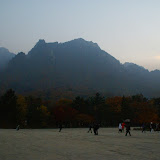
Seoroksan is not an usual sight. It's sharp white peaks arising straight from the sea level leaving just a minor space for Sokcho city to hug in between leave a newcomer with a sight curved into the head forever.

The National Park is said to be a very center of Korean hiking tourism, is also said to have crowds of people on every trail. Apparently we were lucky.

As we went uphill along a V shaped rocky valley with a creek in it's bed we gradually avoided human beings. Those who we met were of it's special kind, the kind which makes it to the mountains for a prayer, for a reunion with Creator, reunion with Mother Nature. Buddist monks with their bells and catholic nuns with their rosaries, and middle aged Korean hikers, families, friends in groups by 2, 3 or 4.

The sky was blue and the air seemed chilly and sharp with it's touch of mountain freshness. Wind blew steadily and leaves were falling down the trees in all sorts of autumn colors. Despite the wind there was also this silence, this point on the way which forces naughty human being to stop, to slow down, to reflect.

A range itself is an amazing example of precambrian - paleozoic geological structure. Rocks forming the penninsula are very old of all sorts: ingenous and sedimentary as well marbles and other methamorphic ones. Grey paleozoic limestone has been eroded away by water giving space to steepy walls of more resistant gneisses which especially in Seoroksan have their stripe structure visible everywhere. Apart from gneisses, also porphyry and ryolites, limestones and slates are everywhere.

Huge stones in river beds may surprise a visitor. Does water really have that much power? It has, during sudden downpours it can move huge rocks on it's way.

A hiker goes and cherishes his eyes with these wonders of nature, so old and majestic. The average altitude is not bigger than 1700 m above sea level but the bottom of the mountains is at sea level so it gives altogether 1700 m of relative altitude difference.

People bewitched with it's beauty will become calm and friendly. Silently help eachother or show their enthusiasm by wholeheartedly greeting a stranger. Just as we did with Darren and Jo. Sudden hiker you meet on the way and start talking and spend nice time with connected by common challenges and spirits is the best part of mountain hiking.

The only thing which may spoil the taste of nature is unfriendliness of hut managers. Korean extreme capitalism had reached even here. Everything is traded for high price everywhere. Maybe their unfriendliness is also a part of the social spirit and structure? As mountain rescue officers they are the bosses and they are on top of the hierarchy which may excuse their unapprochable attitude. It is seen in front of the hut when Korean hikers are using their own gas to boil the water instead of having it done by the rescue man if he is around in his hut. He eventually gave us a bit of hot water to our thermal bottle - but - as a result of huge quarrel which really spoiled our moods for a while. We have experience with hot water given for free everywhere in every mountain shelter. Because it is just hot water and because it may save your life.

But this small bitter taste did not spoil our overall impression, which we still have. We still see the stones, hear the mountain creek and feel the silence of nature.

Good morning or good evening wherever you are
Aga

__________________________________
Practical information:
To Seoroksan: Take a bus to Sokcho City and decide which park gate you wanna take later
There are two bus terminals, one directly on the way to the main gate another one more away from it.
Bus ride from Seoul is 25000 KRW approximately.
Motel stay is 50000KRW for a room approximately.
To the gates of the park there are buses leaving from the other terminal close to the Fish Market.
Important: get some reasonable maps from somewhere else than the information center. All what you get there is oversimplified idiot's version. The times given are for really sportive hikers who just run. If you want leisure time, reasonable pleasure with views and some photoshooting multiply the times by 1.5 at least. If you want to have a hot dinner, better take field cooking device with you. Ok, that's all of my preeching for this time lol :)

Friday, 22 October 2010

CNN Poland Korea - Global Connections


Last tuesday a lady from CNN asked me if I agreed to show on Global Connections as they have a Poland -Korea week ongoing.

It prooves imagination and high IQ actually to spot the simmilarities and connections between the two countries, cause they are there and many of them.

In OECD ranking Polish and Koreans work the longest hours in developed countries outscoring demonized USA by 7 places.

Unlike other rather cool and hush down East Asians, the Koreans are hot-tempered and one has impression that they tend to blow up even in business, and this happens to Polish as well. We do quarrel and blow up a lot, enough if I mention my dad who is like a volcano.

On Global Connections website people had been putting thoughts which popped up in their minds on the topic.

From very accurate like simmilarities in folk cuisine - cabbage (sourkraut) and dumplings, to very absurd and idiotic like paper cut and caligraphy paper.

Here I come to the very core of my point. Making superficial remarks by American who doesn't speak proper Polish anymore and had maybe one Polish grandfather does not make much sense here, does it? Yet it very often happens. So, according to some Polish-American Polish culture is all about "wy -chee - naan - kee" how he had written it in the website.

Never again mention paper-cut as something core important in Polish culture if you don't actually know it and have never been there. Polish folk culture differs a lot and when you drive 30 km the folk traditional dress maybe already the whole different. Paper cuts were peasants solution for cheap wall decorations in a region which is much smaller than Warsaw nowadays and it was ... more than 100 years ago, so it has now a museum value and is not a living culture at all. Therefore attaching it as something called "Polish culture" may be strongly insulting.


If you really want to know what Polish culture is about, get to know Możdżer, Chopin, Penderecki, Kilar, Polanski, Kieslowski, Kossak, and so on and so on. If you are interested in folk culture, move your ass and come before you say that "paper cut" is what defines it. 

Core difference is that Korea had been a feudal state until 1910, and Poland had first form of democracy established as early as 1570. Therefore Korean culture is strongly homogenous, but even they had also had astonishingly beautiful poetry and even for them it may be insulting to be associated with cabbage and paper.


*************
Though I must admit that EXPO had been a success in terms of architecture. The EXPO -POLAND  building
had been copied around whole Asia including Dubai, and within first 4 days of the show, 28000 people visited the building. Maybe those who visited will, after all, go to visit and discover even more. And especially that modern buildings in Warsaw are not made of "Wy Chee  nan kee". 

*************
The show on CNN was cool. It was very nice to get some recognition as a country on CNN, however so late. Global stocks, inverstors, funds, and business would not admit it but invests a lot in "Warsaw" related entities, bonds, financial instruments and others. As Jack Nicholson said" Better Late Than Later". Korea was also a veeery long time ago discovered by international business. Only media, as usual, are the latest.

I appeared on the show for brief second, and I do promise that I will never ever do it again because it is not nice and not professional to be "grey citizen" speaking for CNN. I had no make-up cause the lady was late, had forgotten the appointment and all my nice cloths, nice hairstyle and nice makeup was gone when she finally contacted me at more or less 1 am.

The photo shows Polish pavilon on EXPO. Wy -chee-naan-kee. Enjoy.

Wednesday, 22 September 2010

Chusok

It's Chusok now.
The most important holidays in Korea. It is on the 15th of 8th lunar month, so it is either in September or in October of the Gregorian solar calendar ( means the calendar we use globally).

The encyclopedia says that it is 2000 years old harvest festival in Korea. It is also sort of thanksgiving day, though not to the God as it used to be in the West, but to the ancestors.

It is a time of enormous traffic, as most of the inhabitants of Seoul are people who live here for  no longer than 50 years. Most of these modern nuclear families go to the countryside to visit their relatives and on the Chusok day pay respects at their ancestors graves.

The ancestors worship originates from primeaval Korean times, longer than confucianism, buddism taken altogether. It has it's roots in Shamanism, in times when harvest was crucial to survival of the group (clan) and ancestors were worshipped as the source of care and inherited group wisdom shared spiritually by all of the members of the tribal village. In ancient Korea there were several shamanistic influences both from the South and from the North, nevertheless with the similar characteristics in it.

Ancestor worship was digested by buddism and taken as part of the belief system, later confucianism also did not fight with this as it fell into the category of filial piety.

What is Chusok now? It is difficult for a foreigner to grasp. All we see is that buses are not that much crowded, on subway there are less people, less cars race down the streets. The lazy relaxed athmosphere is somehow in the air.

I have learnt from my Korean friends that Chusok requires lots of preparations. Ideally these are women of all generations gathering together for baking song pyun and cooking japchae. Song pyun are traditional rice cakes, very delicious, and japchae are friend brown noodles, something worth to try.

Sometimes guys help in these preparations as well, especially in the families where there are no girls. Chu Won, my ex- coworker, helps his mother a lot during Chusok and Sollal.

In the old times there used to be common gatherings and festivals in the villages, just like globally in the rural society getting together is an important thing.

Currently Koreans cook and eat, but they also play games or watch movies. Encyclopedias say that they also make their traditional dances in the evenings, but I haven't seen it in my own eyes.

Not everyone goes home though. Some troubled young people or those who quarelled with their families, go nowhere.

Chusok is a test of character for many. Together with Sollal, Chusok is also a time when couples suffer, cause no matter how much in love they are, usually both have big family assemblies. In the West, we would not invite someone casual, but a serious partner shares our family holidays. It's actually a test for the relationship, as to how serious it is. Here though, even if the relationship is serious, people are still parted for that time. I have no idea yet how is it with married couples, this is yet to discover.

And dear Iris, Doe Won, I will never forget your invitation for Sollal. Time which we, foreigners, could share with you and your family at your family table on the first day of Lunar New Year.

*****
Source of a photo: http://rice-cake.info/

Thursday, 2 September 2010

Climate typhoons etc

Last night the typhoon hit South Korea's capital area including the city where I live, Suwon. We woke up in the middle of the night, both of us, not knowing what to do next. Things were flying in the air and trees were falling down. After 4 hrs or so it all calmed down, but the remains of fallen trees are still there. In Seoul several people were killed.  Now I know what the tropical storm is, and I didn't wake up for the worst part of it, which my friend survived in a lonely nervous silence. Two weeks ago, back in Poland, I've been through worse things though ( but that's an offtopic).


Climate in Korea is warm temparate monsoon with influences of subtropical. It varies depending on the lattitude.
Winter normally is cold and dry, with not much snow, except for recent times. Autumn is beautifull, but short, characterizes in beautifull colors of leaves on the trees. It also doesn't rain a lot during the autumn, compared to the monsoon time. Spring is warm and nice with not that much rain either.  In summer, when monsoon season starts, it rains a lot and it's also humid. Humidity in the air exceeds 90%, means that all you wear or touch is wet.

I survived the storm inside the building and I will take some photos of the remains and present them here.
As I was sitting in the embrace of quite safe modern building very sure that nothing will happen to me, I thought of how big progress Asian countries made over recent decades. I remember the phrase from James Clavell's Tai-Pan in which on the island of Hongkong in the end of the 19th century Tai-Pan's beloved asks the question: - Where are we going to hide, Tai-Pan?
And he replies:

- There's no refuge from typhoon My Love.

They both die in each other's embrace killed by the tropical storm.
*******
Each time I think about this I appreciate the engineering skills of construction. We survived the storm unscratched as we all live in modern buildings.