I did not do a single one productive thing for the whole day so at least I decided to write this entry. South Korean overdone consumerism has always driven me a little bit nuts. Especially that it is very homogenous consumerism and that I am a part of it each time I go to Starbucks. Each time I go anywhere else. Or each time I just go out of my industrialized prison camp at Ajou.
The place where it is especially felt is DMZ - Demilitarized Zone. I have written a bit about this one here or there. But this time it is really an unforgettable advert.
photo by Justinas Simanavici
''Thirsty? Try a DMZ water, fresh from the purity of intact land", says an advert of one of the brands which apparently found the way how to earn cash on the lasting Korean conflict. Crowds of tourists dragged by curiosity each year come to learn something about the situation in the penninsula. Mistery of last hermit non globalized country in the world is what brings them here. They want to feel that, experience that, how does it taste to be in clear and present danger.
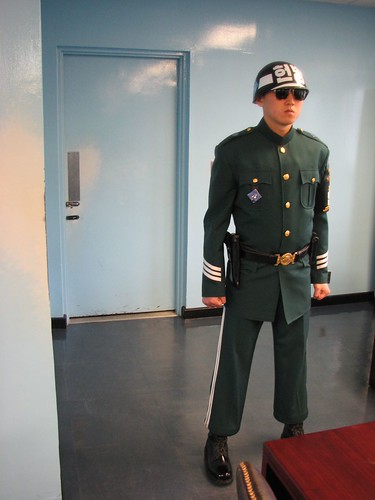
South Korean soldier stands still protecting tourists from North Koreans...propaganda? Photo by Nathan Price
Typical program of the tour to DMZ is to see Panmunjom where Joint Security Area is located, watch North and South Korean soldiers who stand like salt statues half starring at each other. After that one is taken into a very well equipped tunnel which, as US soldiers in the role of guides say, had been digged for the purpose of infiltration. After portion of movies showing hope for reunification one is taken to a souvenir shop. Well, souvenir shop sells a tourist what reminds him about a visit to any tourist attraction later. But is it really a good idea?
Good or not, organizers will not let you get lost, they made sure to indicate which way is North Korea and which way is the toilet ( very needed sometimes ) and which way you may go to buy a souvenir T-shirt after you defected successfully.
photo by Nathan Price
Cheap souvenirs, cups, magnets, t-shirts and gadjets of all sorts with DMZ written on it contrast very sharply with dangerous communist buildings on the other side and soldiers ready to fire a gun in a blink of an eye.
There are even better things. A plastic worm just next to Korean warfare reminds you that it is only a tourist trip. When you are bored with all that talking about conflict, reunification, etc, you may also drop by amusement park nearby. And when you are thirsty, drink DMZ water.
photo by Justinas Simanavici
This all represents the reality of two different countries of both sides. After all, South Korea is a capitalistic democracy and has right to do cash on anything it wants. But it poses a question, what happens to DMZ if ever it stops being the most hostile border in the world? Will it be changed into a National Park because it has intact ecosystem, or will be changed into another land of skyscrappers and Starbucks? That is the question.
***********
Thanks to Justinas Simanavici and Nathan Price for these photos above.
You can visit Nathan's blog here: http://bigbadboonis.blogspot.com/, it is full of satiric eye comments, some of them sharply described impressions from DMZ
Blog related to my on & off Korean Experience. Tourist, Expat, Social, Environmental and other issues. And my satiric eye on it. I will occasionally write about other Asian countries as well. When you browse internet for photos, would you care to ask me for permission to re-use them?
Thursday, 6 January 2011
Monday, 3 January 2011
Reading on: The Koreans
Michael Breen is an author I recommend for decent insight into contemporary Korean affairs.
"The Koreans. Who they are, what they want, where their future lies" is a book that had been published several times already and gives a brief and light encounter into Koreas mindset and sketches history. This really helps in understanding what makes a present day Korean.
However I would argue that Breen is wrong in several opinions he forms in the book. In the chapter titled "Two ways to be Korean" he states leaving safe rhethoric question mark, that Koreans could have prevented their division. There were too many leaders with far too many opinions and ideas.
Domestic freedom movement inclueded moderate nationalists who, similarly to Poland during positivism, decided to develop educated elites to be able to take over later on. This did not really succeed, mostly because the outbreak of war with China changed the course previously imposed by Japanese governor Satamoto. Satamoto gave room for limited Korean activities in terms of language and culture, decided to establish Korean press, the oldest of which, Chosun Ilbo, had just celebrated it's 90th anniversary last year.
In such circumstances moderate independence movement was created and had been growing. Until the outbreak of 2nd World War in the Far East, when Japanese authorities had shown the most horryfying face not just to the Koreans but also to other nations in Asia. All previously allowed activities had been banned. Development forced by Japanese war machine created as well many opportunities of jobs which had tempting wages. During that time most of the Independence Movement leaders lost credibility as they either collaborated or were broken by merciless investigations. Those who would later create modern Korean states were born abroad or returned from exile: Kim Il Sung and Syngman Rhee, who is described in one of the previous posts. Syngman Rhee for sure holds responsibility for rival attitude to his political counterparts but so would be anyone holding his position.
Modern Iraqis and Kurdish face the same problem, they have obviously too many voices and too many leaders. I will use this example as parallel. Although they have too many leaders, they depend on foreign stronger powers in as to who actually would hold the position of the president. Initially the first leader was Allawi, the closest friend of USA, however maybe not the most popular among Iraqis themselves, but accepted by foreign powers.
It was the same situation in Korea. Foreign powers decided to play for a piece of cake. Literally Soviet Russia decided to establish communism on the Korean penninsula and USA had secured the Southern part up to 38th parallel. But they designated Syngman Rhee as a first leader of Korea simply because he spent there most of his life and they knew him. They had no idea about any other leaders even if they would be better for the country. At second in a game between two ideologies there was no room for unified leadership. I contradict Michael Breen on his argument. My answer is no, they could not have prevented their own division. And rightly so, at least citizens of the South can strive for building their own future with increasing citizens participation.
*********
On side from the main argument I must admit that however stupid and short sighted may US foreign policy be, bravery of her field troops saved a lot of dreams in the world and had stopped numerous genocides up till now. Unjustified and non-needed action in Iraq had changed American course for many years and caused her withdrawal from president Wilson's commitment, that every nation has right to self representation and democratic development.
"The Koreans. Who they are, what they want, where their future lies" is a book that had been published several times already and gives a brief and light encounter into Koreas mindset and sketches history. This really helps in understanding what makes a present day Korean.
However I would argue that Breen is wrong in several opinions he forms in the book. In the chapter titled "Two ways to be Korean" he states leaving safe rhethoric question mark, that Koreans could have prevented their division. There were too many leaders with far too many opinions and ideas.
Domestic freedom movement inclueded moderate nationalists who, similarly to Poland during positivism, decided to develop educated elites to be able to take over later on. This did not really succeed, mostly because the outbreak of war with China changed the course previously imposed by Japanese governor Satamoto. Satamoto gave room for limited Korean activities in terms of language and culture, decided to establish Korean press, the oldest of which, Chosun Ilbo, had just celebrated it's 90th anniversary last year.
In such circumstances moderate independence movement was created and had been growing. Until the outbreak of 2nd World War in the Far East, when Japanese authorities had shown the most horryfying face not just to the Koreans but also to other nations in Asia. All previously allowed activities had been banned. Development forced by Japanese war machine created as well many opportunities of jobs which had tempting wages. During that time most of the Independence Movement leaders lost credibility as they either collaborated or were broken by merciless investigations. Those who would later create modern Korean states were born abroad or returned from exile: Kim Il Sung and Syngman Rhee, who is described in one of the previous posts. Syngman Rhee for sure holds responsibility for rival attitude to his political counterparts but so would be anyone holding his position.
Modern Iraqis and Kurdish face the same problem, they have obviously too many voices and too many leaders. I will use this example as parallel. Although they have too many leaders, they depend on foreign stronger powers in as to who actually would hold the position of the president. Initially the first leader was Allawi, the closest friend of USA, however maybe not the most popular among Iraqis themselves, but accepted by foreign powers.
It was the same situation in Korea. Foreign powers decided to play for a piece of cake. Literally Soviet Russia decided to establish communism on the Korean penninsula and USA had secured the Southern part up to 38th parallel. But they designated Syngman Rhee as a first leader of Korea simply because he spent there most of his life and they knew him. They had no idea about any other leaders even if they would be better for the country. At second in a game between two ideologies there was no room for unified leadership. I contradict Michael Breen on his argument. My answer is no, they could not have prevented their own division. And rightly so, at least citizens of the South can strive for building their own future with increasing citizens participation.
*********
On side from the main argument I must admit that however stupid and short sighted may US foreign policy be, bravery of her field troops saved a lot of dreams in the world and had stopped numerous genocides up till now. Unjustified and non-needed action in Iraq had changed American course for many years and caused her withdrawal from president Wilson's commitment, that every nation has right to self representation and democratic development.
Sunday, 2 January 2011
Multi-culti Ansan City
...in other words just cool story.
The plan was to go to Oido just because there supposed to be a seaside over there.
But as I was at Sadang Station in Seoul, subway was heading for Ansan and the plan got naturally amended on the spot. Destination Ansan.
What is interesting in Ansan? People say that birdwatching is possible. Somewhere around the city scholars from SNU had even made a documentary about night birds, like owl. The documentary was shown on BBC a year ago.
Just as I got off at Ansan Station I immediately got involved into my favorite one: peoplewatching. Indeed spectrum of cultures and different faces is enormous. Languages spoken differ among mongolian, vietnamese, indonesian and others.
...so many different faces
All of them starred at me top-down screening with curiosity or some dirty thoughts in case of male. Indeed a European dressed in red hiking set is a rare view over there. These immigrant inhabitants of the city are not the richest obviously. Their skin is not radiant, eyes are tired. Some of them try to rest under thick blankets while trading something.
...they are tired
I didn't quit hopes to find that birdwatching site and was wondering among the streets until in some park I heard so common sound:
-Natasha! Natasha! Kuda Ty? Natasha, where are you? - some people looking like Asians were calling someone.
- Izvinite, Wy govorite pa angliyskiy? Do you speak english?
-Niet, ne horosho. Sorry, no.
- Mnie nada posmotriet' ptitsy, Wy znaete gde ya mogu naiti ptitsnyj rezervat? I want to find some birds for birdwatching, do you know where is it possible?
- I am sorry no. Wy gavarite po russkiy otschen' hortosho, Wy otkuda? Kakaya u Was yest kamyera? - a gentleman asked me about my camera, as apparently he was a photo freak as well. Also said that I speak russian well. I don't but nevertheless it was already another time my russian skills where very useful in Korea.
- Sony Alpha 100, eto gavno yest - I critisized my camera in non exactly most classy russian expression.
-Potshemu gavno? Moshna dyelat horosho. It's not that bad after all.- replied my new friend.
Eventually I learned that the gentleman was from Tashkent in Uzbekistan working in Korea. He kept asking where was I from.
- Ya iz Polshy. I come from Poland. - said I.
...cyrylic and hangul, happened every 500m
- Ach z Polski, w Uzbekistanie moim szefem był Polak. Back in Uzbekistan my boss was Polish.. We are both Koreans born there during Stalin times. Many Polish were also dragged by Stalin and this is how I learnt your language a little bit.
At this point I quit attempts to find birds and instead enjoyed people. Ended up having Polish-Korean-Uzbekh dinner and after I headed home.I must admit that I did not expect finding a Polish speaking Korean from Uzbekistan somewhere in Ansan which is not the biggest city at all.
The plan was to go to Oido just because there supposed to be a seaside over there.
But as I was at Sadang Station in Seoul, subway was heading for Ansan and the plan got naturally amended on the spot. Destination Ansan.
What is interesting in Ansan? People say that birdwatching is possible. Somewhere around the city scholars from SNU had even made a documentary about night birds, like owl. The documentary was shown on BBC a year ago.
Just as I got off at Ansan Station I immediately got involved into my favorite one: peoplewatching. Indeed spectrum of cultures and different faces is enormous. Languages spoken differ among mongolian, vietnamese, indonesian and others.
...so many different faces
All of them starred at me top-down screening with curiosity or some dirty thoughts in case of male. Indeed a European dressed in red hiking set is a rare view over there. These immigrant inhabitants of the city are not the richest obviously. Their skin is not radiant, eyes are tired. Some of them try to rest under thick blankets while trading something.
...they are tired
I didn't quit hopes to find that birdwatching site and was wondering among the streets until in some park I heard so common sound:
-Natasha! Natasha! Kuda Ty? Natasha, where are you? - some people looking like Asians were calling someone.
- Izvinite, Wy govorite pa angliyskiy? Do you speak english?
-Niet, ne horosho. Sorry, no.
- Mnie nada posmotriet' ptitsy, Wy znaete gde ya mogu naiti ptitsnyj rezervat? I want to find some birds for birdwatching, do you know where is it possible?
- I am sorry no. Wy gavarite po russkiy otschen' hortosho, Wy otkuda? Kakaya u Was yest kamyera? - a gentleman asked me about my camera, as apparently he was a photo freak as well. Also said that I speak russian well. I don't but nevertheless it was already another time my russian skills where very useful in Korea.
- Sony Alpha 100, eto gavno yest - I critisized my camera in non exactly most classy russian expression.
-Potshemu gavno? Moshna dyelat horosho. It's not that bad after all.- replied my new friend.
Eventually I learned that the gentleman was from Tashkent in Uzbekistan working in Korea. He kept asking where was I from.
- Ya iz Polshy. I come from Poland. - said I.
...cyrylic and hangul, happened every 500m
- Ach z Polski, w Uzbekistanie moim szefem był Polak. Back in Uzbekistan my boss was Polish.. We are both Koreans born there during Stalin times. Many Polish were also dragged by Stalin and this is how I learnt your language a little bit.
At this point I quit attempts to find birds and instead enjoyed people. Ended up having Polish-Korean-Uzbekh dinner and after I headed home.I must admit that I did not expect finding a Polish speaking Korean from Uzbekistan somewhere in Ansan which is not the biggest city at all.
Saturday, 1 January 2011
Guinsa Temple Part 1
This Christmas happened to be spent at Guinsa Temple, where I decided to go in the very aim to perform perpetual state of motion, hence go.
When 3 people travel, their personalities differ and they have to compose a society in it's mini scope for a given number of days or hours. It is a perfect school of tolerance and friendship. 3 of us, Polish, German... and not Russian ( like would be in that joke from past) but Lithuanian on the go. Louisa, not the fastest person in the world, but one of the smartest, Svajune, haste on going and punctual, and me, rather quiet on the journey, prepared trekker, and taking a lot of brain shortcuts which can have consequences at times. And it had during our preparations when I didn't tell Svajune beforehand that we are actually supposed to be ready for survival in terms of dressing and equipment. But, nevertheless Svajune is tough and made it in her own outfit. And even made a profit out of it, but let the story go as it goes...
We got off the bus in Korean equivalent of the middle of nowhere. Something simmilar Wild Wild West city in US countryside where both high tech and total bronze age meets in one spot. The bus ticket booth being both the kiosk for whatever needed with the ajoshi inside who looked at us like on the aliens. Prepared to speak my limited Korean I asked: Guinsa odiye isoyo. He looked at me again with bored sight of a man who had seen so many people and faces that I don't matter at all and shown the direction up and right.
Darkness around and reflections of street lights sparkling on the icy pavement up. By that time I got questions if we are at the right place and if we shouldn't go back to the bigger city and remarks that adventures in negative temperatures are not the best solution. Ignored them all: - Go. - said I. And headed upwards in the night full of stars.
I wish it was a longer walk. Surprisingly close I saw the complex of traditional roofs and new we are at the place. Svajune entered the office of the temple to ask... for two nights. Yes. Two nights.
An A4 size modest piece of paper at the door said in printed capitals: "For english speaking service please ask inside". In a moment cheering face of Svajune appeared back and said to us: - Wait 5 minutes
and an english speaking person will come to us.
It was a first time to get off my trekking shoes and not the last one. Inside there was a counter behind which I saw something like a combination of a theater closet and an office, just like a night watch would have his computer for whatever job. We waited on a heated floor.
Darkness around and reflections of street lights sparkling on the icy pavement up. By that time I got questions if we are at the right place and if we shouldn't go back to the bigger city and remarks that adventures in negative temperatures are not the best solution. Ignored them all: - Go. - said I. And headed upwards in the night full of stars.
I wish it was a longer walk. Surprisingly close I saw the complex of traditional roofs and new we are at the place. Svajune entered the office of the temple to ask... for two nights. Yes. Two nights.
An A4 size modest piece of paper at the door said in printed capitals: "For english speaking service please ask inside". In a moment cheering face of Svajune appeared back and said to us: - Wait 5 minutes
and an english speaking person will come to us.
It was a first time to get off my trekking shoes and not the last one. Inside there was a counter behind which I saw something like a combination of a theater closet and an office, just like a night watch would have his computer for whatever job. We waited on a heated floor.
- Welcome to Guinsa Temple! - a cry of energy greeted us from the right- I am Hyondok Synim and I shall be your guide from now on. Let's do the formalities.
We went through all sorts of questions from where we were and how we got there. Svajune brought her attention to Lithuania... - There was a man here, Justas, helped to make kimchi. He was from Lithuania too. Somehow I could not imagine my decadente friend Justinas making kimchi with ajummas, but an image of him with a cigar between his teeth and a blink above the pot of kimchi persecuted me in my brain and I bursted with laugh. Girls too. Mind reading?
Our nun was 50, fluent english speaker, with a height of mine and dark hair put in a tight not on the neck. Dark grey uniform, dark grey long coat and she would be alike thousand others if not for this amazing energy inside her which was glowing around the person. The way she moved and talked. The way she looked.
- Merry Christmas. Please feel welcome at our Temple and enjoy pace of time with us. There is only one God and only one good. Baby Jesus was born today and I want you to feel the athmosphere of Christmas even
when you are at buddist temple. - that came after asking us about religion. However tensed and complicated is my relation with God I don't deny Him so I admitted to be Roman Catholic. Not for the first time I was wondering what story does "our" Hyondok Sunim carry on through her life. The very moment I met her I knew she was not an usual person.
- You are very lucky. You arrived during the preparations for Buddha anniversary. There is also an ongoing month meditation going in our monastery, some of these people I will show you because of your book.
We followed her to the Dharma Hall passing all the impressive buildings. All of them full of concrete and Joson dynasty style assemblies in it's final touch. "Is Korean architecture really that homogenous and it does not differ from the corner to the corner?" again question in my brain. The answer to this question is one of the main purposes of my stay in Korea.
Nun brought us to the cafeteria looking like any other cafeteria. Full of women with children, and only 5 men. Gradually it went empty and we stayed alone. This is when she brought some friends with her. A young
one, and old one and a middle one. She put the cake in the middle and said. - You were brave during the meal (it was adressed to Louisa) so you deserve something sweet now. My young friend here has her
birthday. This is her mother. And this is my other friend - said she indicating at the old small lady with white hair. So silver that she must have been 90 by that time. Peace in her smiling eyes told that she has been through so much that she already aquired this absolute tolerance and acceptance for all phenomena in human beings. We went on chatting and asking questions. Now I think that the old lady was a guide for the young one in spiritual development. Her presence had not been merely of social manner.
To be continued...
******************
Practical information: bus to Guinsa goes from Dong Seoul terminal every hour or so.
Once in temple you aren't supposed to leave any food you are given.
Enjoy :)
Friday, 31 December 2010
Pati isoyo
It's just me. Work. Write, travel, do photos, write. Read. Sometimes talk.
Until it is some 1st May, 3rd May, 15th August or Silvester like now. And I end up having nothing to do because I never plan anything like that if I have too much work.
On a haste we decided to have common dinner. My Iranian friend Mona is an excellent cook and I really felt good with her companionship for the day.
At some point there was an idea to go to the Big Chill, our favorite bar in Suwon, where the fate had placed us to live at the moment. "Aga, are you coming? It's 11 pm? " a desparate sms from my Georgian friend Irina. Yes, sure I do, but first we need to get taxi. We went down to an ajoshi who is our watchdog and makes sure we don't get wasted in the dorm.
"Taxi obsoyo, no taxi, busy" our watchdog told us in broken english. My broken Korean was able to comprehend what he wanted to say.
In this case we left our industrialized prison camp and headed to the main street. Or so we thought that we ought to head to the main street. "Let's hitchhike" thought I seeing a guy next to the car at the lot. I stopped him and said "Happy New Year whoever you are and whatever are your plans. We are women as you see and if you wanna have a ride with two good looking ladies please take us to Nammun. Chinguryl mannayo" said I hoping that he was gentleman. To be frank I have no idea how did he look like, only that he was taller than me. Maybe Mona does. Maybe not. It was dark.
Does it sound spooky? Two foreign women stopped the car and abused a Korean young man? Well, he seemed to more than enjoy to drive us to Nammun where my friends where more than happy to see us.
Nate, thanks for the pool game. One of the most unequal in my life, but companion matters, not winning. Irina, thanks for dragging me out. Mona, thanks for the dinner. Nick, for being a DJ. All of you, just for being.
To my anonymous friend in the big sexy Hyundai: thank you for being as well. Thanks to you I could wear my summer shoes. You are our:
yes exactly. You are our pride of dorm. If you were not Korean it would not happen. So this is why I love Korea too.
Happy New Year people :)
Yeah, forgot to mention that I got wasted a bit so the tradition was fulfilled. And the taxi way back was just there the moment we went out of the bar. I like it.
Until it is some 1st May, 3rd May, 15th August or Silvester like now. And I end up having nothing to do because I never plan anything like that if I have too much work.
On a haste we decided to have common dinner. My Iranian friend Mona is an excellent cook and I really felt good with her companionship for the day.
At some point there was an idea to go to the Big Chill, our favorite bar in Suwon, where the fate had placed us to live at the moment. "Aga, are you coming? It's 11 pm? " a desparate sms from my Georgian friend Irina. Yes, sure I do, but first we need to get taxi. We went down to an ajoshi who is our watchdog and makes sure we don't get wasted in the dorm.
"Taxi obsoyo, no taxi, busy" our watchdog told us in broken english. My broken Korean was able to comprehend what he wanted to say.
In this case we left our industrialized prison camp and headed to the main street. Or so we thought that we ought to head to the main street. "Let's hitchhike" thought I seeing a guy next to the car at the lot. I stopped him and said "Happy New Year whoever you are and whatever are your plans. We are women as you see and if you wanna have a ride with two good looking ladies please take us to Nammun. Chinguryl mannayo" said I hoping that he was gentleman. To be frank I have no idea how did he look like, only that he was taller than me. Maybe Mona does. Maybe not. It was dark.
Does it sound spooky? Two foreign women stopped the car and abused a Korean young man? Well, he seemed to more than enjoy to drive us to Nammun where my friends where more than happy to see us.
Nate, thanks for the pool game. One of the most unequal in my life, but companion matters, not winning. Irina, thanks for dragging me out. Mona, thanks for the dinner. Nick, for being a DJ. All of you, just for being.
To my anonymous friend in the big sexy Hyundai: thank you for being as well. Thanks to you I could wear my summer shoes. You are our:
yes exactly. You are our pride of dorm. If you were not Korean it would not happen. So this is why I love Korea too.
Happy New Year people :)
Yeah, forgot to mention that I got wasted a bit so the tradition was fulfilled. And the taxi way back was just there the moment we went out of the bar. I like it.
Happy New Year 2011
To all my readers - Happy New Year 2011.
My all your decent wishes come true and indecent be forgotten :)
Wednesday, 22 December 2010
Sleeping with the enemy part 2
Yesterday I attended Christmas dinner at my ambassador's residence.
As we had been talking and mingling among each other the topic of recent events came up naturally and we had been wondering what comes next in inter- Korean relations and how it may affect our lives as expatriates.
Although general public does not care at all, the government does. At some point I said that I admire their cold-blooded reaction for Cheonan sinking in March, as in the West it would probably result in war. My current boss said that the chain of avoiding responsibility and pushing decisions as high up as possible is what makes that cold-blooded reaction. I cannot repeat here all the comments and remarks for obvious reasons. Although everyone agreed that life in Korea is like sleeping with the enemy. I heard that once from Swedish colonel from the Panmunjom base. In my recent coverage for press it is confirmed by many statements from guys who had accomplished military service. The threat is there and life goes on. Thrilling and toxic in one.
A year ago one of my readers asked me what would be the path to reunification and whether I believe in it or not. And if I could describe North and South Koreans as two different nations. I ask such questions very often and I see that the attitude varies depending on the generation and on the position. Older people repeat like mantra that there are only one Koreans and that South Korea moves on behalf of North in the international scene as well. The theme of broken families appears every now and then too.
But younger generation if asked really thoroughly replies clearly that North Korea is a problem, but it should be reseolved differently and that even if the regime changes one day they do not want 20 million of hungry people to be fed at their expense. They do not want higher taxes and no longer feel any kinship. If it was me to bet what is going to happen in the future, I bet that there will be two Korean states. They will maybe merge one day but only in a federation and only if the North catches up economically.
Are they two nations? Maybe... already yes maybe not yet. But... the first layer of Korean mentality is hierarchy and kinship - this is common for both South Koreans and North Koreans. Equally important in both societies. But the core difference is in the layer which was created very recently - the attitude to consumerism and competition. The attitude to democracy and acceptance of different ideas. Despite some 50 000 North Koreans who stay hidden in China and numbers in other countries, majority is behind the iron curtain brainwashed and convinced that elsewhere are only problems, diseases, AIDS, terrorism, etc. If even some of them watch South Korean dramas in secrecy, there is a chance that their mindset is non-capable of accepting modern capitalistic competition and requires a lot to be just given - a phenomenon known as homo sovieticus. South Koreans are totally different. Accept rat's race and competition, public debates, differences in the opinions as part of the normal daily life. My answer is yes, they are on the way to split forever.
As we had been talking and mingling among each other the topic of recent events came up naturally and we had been wondering what comes next in inter- Korean relations and how it may affect our lives as expatriates.
Although general public does not care at all, the government does. At some point I said that I admire their cold-blooded reaction for Cheonan sinking in March, as in the West it would probably result in war. My current boss said that the chain of avoiding responsibility and pushing decisions as high up as possible is what makes that cold-blooded reaction. I cannot repeat here all the comments and remarks for obvious reasons. Although everyone agreed that life in Korea is like sleeping with the enemy. I heard that once from Swedish colonel from the Panmunjom base. In my recent coverage for press it is confirmed by many statements from guys who had accomplished military service. The threat is there and life goes on. Thrilling and toxic in one.
A year ago one of my readers asked me what would be the path to reunification and whether I believe in it or not. And if I could describe North and South Koreans as two different nations. I ask such questions very often and I see that the attitude varies depending on the generation and on the position. Older people repeat like mantra that there are only one Koreans and that South Korea moves on behalf of North in the international scene as well. The theme of broken families appears every now and then too.
But younger generation if asked really thoroughly replies clearly that North Korea is a problem, but it should be reseolved differently and that even if the regime changes one day they do not want 20 million of hungry people to be fed at their expense. They do not want higher taxes and no longer feel any kinship. If it was me to bet what is going to happen in the future, I bet that there will be two Korean states. They will maybe merge one day but only in a federation and only if the North catches up economically.
Are they two nations? Maybe... already yes maybe not yet. But... the first layer of Korean mentality is hierarchy and kinship - this is common for both South Koreans and North Koreans. Equally important in both societies. But the core difference is in the layer which was created very recently - the attitude to consumerism and competition. The attitude to democracy and acceptance of different ideas. Despite some 50 000 North Koreans who stay hidden in China and numbers in other countries, majority is behind the iron curtain brainwashed and convinced that elsewhere are only problems, diseases, AIDS, terrorism, etc. If even some of them watch South Korean dramas in secrecy, there is a chance that their mindset is non-capable of accepting modern capitalistic competition and requires a lot to be just given - a phenomenon known as homo sovieticus. South Koreans are totally different. Accept rat's race and competition, public debates, differences in the opinions as part of the normal daily life. My answer is yes, they are on the way to split forever.
Wednesday, 15 December 2010
Roots of conflict
Popular prejudice in the world perceives South Korea as democratic and liberal society which opposed totalitarian North. In reality the picture is a little bit more complicated than that. Let me introduce you to Syngman Rhee, the first president of South Korea, and the first one of subsequent South Korean dictators.
When Syngman Rhee had taken power as the first president of the Republic of Korea, he faced the reality of a post-war, post-occupation country with a society striving for survival.
In 1945 when the American presence on the Korean panninsula began, the country's economy was totally devastated. Although infrastructure had been spared from larger destruction, anything of economic value had been exploited to the fullest by Japanese military needs during the war.
More over South was the agricultural part of the penninsula with not more than 1/4th of the heavy industry, but in return, a food supplier for 65% of Korea.
Growing tensions with North under the communist regime did not make it any easier either. It is said that between 1945 and 1950 US overseas aid and UNRA donations saved lots of Korean lives, because hunger and starvation occured a lot.
Syngman Rhee was a Korean aristocrat born to a Yangban family. Under Japanese occupation had been involved in resistance movement and because of that was forced to leave the country. In exile he spent most of his life in USA where he gained university education but also continuously campaigned for Korean independence. He was also a member of Shanghai based Korean Provisional Government, however most of the time he stayed in USA.
His time in Korea came when it became apparent that short-term lived war alliance between US and Soviet Union will no longer be continued. Any attempts to discuss the future of the Korea by joint US-Soviet commision had failed and so the armistice line was settled on the 38th parallel. In such circumstances Rhee had started his term in the presidential office. The country urgently needed constitution and it was prepared. It secured a lot of civil rights which general Hodge had previously secured and was largely copied from the constitution of USA but with ready and effective escape clauses that guaranteed the right to impose martial law with direct presidential executive order if any danger arising from foreign relations should occur (Art 57).
Such solution seemed inevitable. Even before establishing the Republic, communist guerillas from the North had initiated a lot of unrest and uprisings. Authorities had been attacked on various occasions, the biggest uprising occured on Jeju-do and started to expand all over the country which faced already starvation and other problems.
These rebelions had been reason which led to the open surpression of civil liberties and excused why the first president of Korea had to act agressively on society by establishing the National Security Law.
By that time (1948) occupation forces withdrew from the penninsula and Kim Il Sung started to prepare for war which eventually broke out on June 25th 1950. The struggle led to a loss of 1 million lives and had been the direct challenge for the UN Chartter. 95% of the territory had been taken over by North Korean communists, some 0,5 mln Koreans were forcely dragged into Soviet lagers or for starvation in the middle of nowhere in vast Uzbekh and Kazakh territories. Seoul had been torn down to debris.
By the time the armistice was eatablished in 1953 Rhee became a ruthless authocrat. Although he bravely opposed the invasion he also used it as an excuse to strengthen his legitimacy and get rid of the opposition. He amended the constitution twice expanding the power of the president and to be elected by public vote. By the end of his term Rhee reminded more of the king surrounded by aristocrats than of a modern democratic leader.
Repressive measures towards society and growing infiltration, control and surpression of human rights using the anticommunism as an excuse had led to clash with American diplomacy. US Secretary of State delivered note stating that Rhee's style of ruling was ''unsuited for free democracy”. Although during this time anti – Americanism has been also growing because the American army had never openly critisized Rhee, all whatsoever critique had been done behind closed doors.
After 12 years in power facing massive growing protests president Syngman Rhee resigned from the office of the president and went into exile to USA.
Some may say that it is not an easy task to run a democratic society which permanently faces danger of war but also internal infiltration and provocations. Indeed history of the world shows that during transition from feudal state into modern democracy some form of autocratic rule often occurs.
Although critiques may say that president Rhee abused power to get rid of the opposition and exagerated threat from the North. In my own point of view both reasons occured. Also as a representative of Yangban family he belonged to the cast which very often had temptation to abuse power. And indeed he had opposition to get rid of.
The number of rival leaders is a very interesting issue itself. Could Koreans have prevented their own division? This question is not to be asked directly and is not answered.
Nevertheless for more than 20 years of it's existence Korean Provisional Government was not recognized by many countries. Too many rival organizations and voices called for the legitimate right to represent the interests of Koreans. A consistent unified voice would maybe change a lot. Syngman Rhee failed to think bigger than his own personal interest both during times of Japanese occupation and also later as president. Rhee took an occasion to became a dictator, just as an occasion makes one a thief. Although he had done one very honourable thing – he knew when to step down. And this was the end of the ROK First Repiblic.
Tuesday, 30 November 2010
Nation branding
I have already mentioned about Korean Nation Branding efforts and how they impress me. In more developed countries than Korea comprehensive nation advertising and public diplomacy took much longer time or is not that well organized.
Part of it is Korean Wave which currently hits Japan, China and other Asian countries. Korean boysbands and girlsbands, so called K-pop music to which you may find links in the video corner is just an example. Korean dramas with Winter Sonata leading among them, singer BoA and many others.
This entry on the blog will also be featured on Arirang TV soon thanks to which hospitality I can share even more stories about country's and city's promotion enterpreneurship.
This year Seoul was choosen as one of the must-visit cities by UNESCO as a result of long term action of the Metropolitan Government. Maybe it was this little creature, Haechi, which was designed as a Seoul brand based on a fictional good spirit, symbol of the city, which caused it? Who knows...
Whether Haechi himself had blessed the city with good spirits or not, he definately works as a brand developed back in 2008. Metropolitan government uses it as a symbol which helps promoting good businesses for tourists.
I was taken for a dessert to one of the restaurants in a Korean traditional house situated in a White Collar area, next to the COEX Intercontinental, the very site were G20 was held. The restaurant which name is Pulhyanggi serves all sorts of Korean food for very sophisticated set of clients who usually go there for business negotiations and incentives.
Inside the Pulhyanggi...
Btw. did I mention that my favorite Korean food is a pancake with seafood which is called haemul pajeon and I can even make it myself?
And this is how restaurants are promoted with the city brand sign:
The Haechi drawing is based on the ancient creature I have already mentioned, which looks like this:
And Seoul area is full of them standing in all sorts of places, both very modern and traditional ones.
As a city Seoul tries to catch up with modernity but also save what is the best from it's ancient spirits. For this all sorts of different things are done, one of them is Cheonggye Stream near Gwanhamun Plaza, or Design Street near Toksugung Palace. There we may find interesting things like design chairs or sculptures as below:
All fitted in traditional historic environment.
Haechi is successful in promoting business as well. An idea which had not been followed by other cities so far as I know. As a brand Hi Seoul is shared by all sorts of small companies which are given support by Seoul Metropolitan Government. The partnership is perfect for both sides: the city promotes itself even better and business gets money and stable environment to grow.
Above is one of the example of the shared brand products. We visited the exhibition with the TV crew from Arirang and were given a gift set with very useful and very nice items including a pen with a flashlight which I use a lot right now.
Haechi itself is a legendary animal representing justice and integrity. The mythical creature distinguishes good from evil and was believed to bring fortune and luck and provide safety from disaster. The creature has been believed to serve as a guardian of Seoul for a long time.
At Gwanhamun Plaza the souvenir shop opened and the top sells are Haechi dolls in all sizes. I got myself the small one... maybe it will bring me the luck?
*******
Just as I shared with viewers of Arirang I will repeat here. Despite constant threat from the North Seoul flourishes. Korea flourishes. South Koreans take steps foreward, round the clock, like a circle in a spiral... strive and persist.
Special thanks to Yoon-mi Jung and her crew who assisted me for more than 6 hrs on a freezing Friday in Seoul driving me around the city wherever I wanted. Thank you for your hospitality and patience. I love Korea!
_________________________
Links to explore:
http://english.seoul.go.kr/gtk/news/news_view.php?idx=7700
http://www.idwseoul.com/interdesignen/user/bizapp/link/link_01.asp?sBBS=0501
Part of it is Korean Wave which currently hits Japan, China and other Asian countries. Korean boysbands and girlsbands, so called K-pop music to which you may find links in the video corner is just an example. Korean dramas with Winter Sonata leading among them, singer BoA and many others.
This entry on the blog will also be featured on Arirang TV soon thanks to which hospitality I can share even more stories about country's and city's promotion enterpreneurship.
This year Seoul was choosen as one of the must-visit cities by UNESCO as a result of long term action of the Metropolitan Government. Maybe it was this little creature, Haechi, which was designed as a Seoul brand based on a fictional good spirit, symbol of the city, which caused it? Who knows...
Whether Haechi himself had blessed the city with good spirits or not, he definately works as a brand developed back in 2008. Metropolitan government uses it as a symbol which helps promoting good businesses for tourists.
I was taken for a dessert to one of the restaurants in a Korean traditional house situated in a White Collar area, next to the COEX Intercontinental, the very site were G20 was held. The restaurant which name is Pulhyanggi serves all sorts of Korean food for very sophisticated set of clients who usually go there for business negotiations and incentives.
Inside the Pulhyanggi...
Btw. did I mention that my favorite Korean food is a pancake with seafood which is called haemul pajeon and I can even make it myself?
And this is how restaurants are promoted with the city brand sign:
The Haechi drawing is based on the ancient creature I have already mentioned, which looks like this:
And Seoul area is full of them standing in all sorts of places, both very modern and traditional ones.
As a city Seoul tries to catch up with modernity but also save what is the best from it's ancient spirits. For this all sorts of different things are done, one of them is Cheonggye Stream near Gwanhamun Plaza, or Design Street near Toksugung Palace. There we may find interesting things like design chairs or sculptures as below:
All fitted in traditional historic environment.
Haechi is successful in promoting business as well. An idea which had not been followed by other cities so far as I know. As a brand Hi Seoul is shared by all sorts of small companies which are given support by Seoul Metropolitan Government. The partnership is perfect for both sides: the city promotes itself even better and business gets money and stable environment to grow.
Above is one of the example of the shared brand products. We visited the exhibition with the TV crew from Arirang and were given a gift set with very useful and very nice items including a pen with a flashlight which I use a lot right now.
Haechi itself is a legendary animal representing justice and integrity. The mythical creature distinguishes good from evil and was believed to bring fortune and luck and provide safety from disaster. The creature has been believed to serve as a guardian of Seoul for a long time.
At Gwanhamun Plaza the souvenir shop opened and the top sells are Haechi dolls in all sizes. I got myself the small one... maybe it will bring me the luck?
*******
Just as I shared with viewers of Arirang I will repeat here. Despite constant threat from the North Seoul flourishes. Korea flourishes. South Koreans take steps foreward, round the clock, like a circle in a spiral... strive and persist.
Special thanks to Yoon-mi Jung and her crew who assisted me for more than 6 hrs on a freezing Friday in Seoul driving me around the city wherever I wanted. Thank you for your hospitality and patience. I love Korea!
_________________________
Links to explore:
http://english.seoul.go.kr/gtk/news/news_view.php?idx=7700
http://www.idwseoul.com/interdesignen/user/bizapp/link/link_01.asp?sBBS=0501
Tuesday, 23 November 2010
Sleeping with the enemy - DMZ
Several recent posts supposed to be about G20 related stuff and the economy. But sometimes more important things pop up and nothing can be done about that.
Today North Korea shot 200 shells at the South Korean Yeongpyeong island injuring 13 people and killing one and putting several dozens homes on fire.
Apart from sinking the Cheonan fregate that was the most important incident since the Korean War. Rising tensions in the region are caused by current power shift in North Korea where supposedly ill Kim Jong Il is trying to put his youngest son as a heir to the regime.
Last Monday I talked to colonel Ulf Persson who works at the Swedish base at Pammunjom. As we exchanged several diplomatic remarks as on such banquet occasions is normal, the colonel joked: "We are sleeping with the enemy".
Although for an average tourist DMZ is nothing special. The possibility of war apparently was so misty that South Korean business invented DMZ brand. Gadjets with DMZ, DMZ cola, DMZ t-shirts sell out very well among tourists who go for a trip to Panmunjom.
Despite that, chaos in the North is apparent. For many years status quo relied on simple exchange: we don't hurt you and you feed us in reward. North Korea was blackmailing doing something small from time to time and receiving economic aid as part of Sunshine Policy of the South government. So on one hand everyone earns money on anything they can and on the other those who have to be aware are aware and the silent tension of warzone is present in the air.
Now it is no longer that sure whether the game has still the same rules. It seems like there is some chaos in the North related to power shift. It is enough that small thing happens between fighting fractions and the war is ready.
The irony of fate is that DMZ is the only genuine ecosystem habitat in the entire penninsula. If the North and South is ever reunited this area might be one of the biggest National Parks in the world, and one of the only in this particular area, where development had paved everything in concrete across hundreds of kilometers. Typical irony of fate shows that where people can't boost, nature does, taking advantage of human hostilities.
Today North Korea shot 200 shells at the South Korean Yeongpyeong island injuring 13 people and killing one and putting several dozens homes on fire.
Apart from sinking the Cheonan fregate that was the most important incident since the Korean War. Rising tensions in the region are caused by current power shift in North Korea where supposedly ill Kim Jong Il is trying to put his youngest son as a heir to the regime.
Last Monday I talked to colonel Ulf Persson who works at the Swedish base at Pammunjom. As we exchanged several diplomatic remarks as on such banquet occasions is normal, the colonel joked: "We are sleeping with the enemy".
Although for an average tourist DMZ is nothing special. The possibility of war apparently was so misty that South Korean business invented DMZ brand. Gadjets with DMZ, DMZ cola, DMZ t-shirts sell out very well among tourists who go for a trip to Panmunjom.
Despite that, chaos in the North is apparent. For many years status quo relied on simple exchange: we don't hurt you and you feed us in reward. North Korea was blackmailing doing something small from time to time and receiving economic aid as part of Sunshine Policy of the South government. So on one hand everyone earns money on anything they can and on the other those who have to be aware are aware and the silent tension of warzone is present in the air.
Now it is no longer that sure whether the game has still the same rules. It seems like there is some chaos in the North related to power shift. It is enough that small thing happens between fighting fractions and the war is ready.
The irony of fate is that DMZ is the only genuine ecosystem habitat in the entire penninsula. If the North and South is ever reunited this area might be one of the biggest National Parks in the world, and one of the only in this particular area, where development had paved everything in concrete across hundreds of kilometers. Typical irony of fate shows that where people can't boost, nature does, taking advantage of human hostilities.
Saturday, 20 November 2010
Gwanaksan
Changes in life sometimes come in shock and haste and can create some mess in one's brain. Each time I want to purify myself, restructure my internal logic and gain some energy, I hike.
The more challenging hike is, the better. Last year I lived at the bottom of Mount Gwanak which embraces with her northern slope Seoul National University Campus. Her view was tempting me every single day, but when I actually tried I had to quit. First because of lack of proper hiking shoes. Secondly because of not overcome fear of space after I spent 45' hanging over 500m steep in a blizzard in Tatra Mountains some 3 years ago. I still remember the moment I had to back off and how terrified I was. I owe it to a very close French friend of mine who carried me down. As simple as that.
This time I live away from SNU but Gwanak like a queen of Gyeonggi Do still reaches her arms towards me each time I see her from the bus. This time I haven't been waiting for anything, I just went. As I created the event on such a haste, noone joined me and maybe even for better?
Something told me to get off at Nakseongdae to pass by the dorm and campus of SNU. Visiting place I used to live before...
the kid's playground on which I swinged away my "moodie" times...
the building in the family dorm I used to live in. So many memories accumulated over time. Irritation, boredom, disgust, fear, hope. Overally good time if I compare it to living in any kind of dorm for singles.
I walked all of my usual path down passing the language institute and the crown of the stadium where I saw the subject of my work at SNU, a magpie, pica sericea, asian type of what we know in Europe as a magpie. The bird which used to be a symbol of Korea and still hangs on the walls of all sorts Korean embassies globally. However is no longer a symbol because people started complaining for something about this bird, what, that I did not understand when SangIm, my professor's wife, was explaining me the issues.
Strongly tempted to drop by the institute resisted and went to the SNU gate to start a hike. It was about 10:30 when I stopped being lazy and made it in my dynamic pace just going foreward gradually higher and higher. Based on my instinct decided to get to the main range and turn left which should drag me to the place I had to surrender beforehand. And there it was... Gwanak range in late autumn sun appeared in front of my eyes and I had a rest for a while.
I was hiking at my own tempo stopping once a while to take a photo. What struck me was that all these legendar crowds vanished somewhere again and in the middle of 25mln city area there was just me and silence. The smog in Seoul makes anything practically invisible from the peak so the feeling of being away from civilization was enormous.
At some point I had to gradually overcome my fears because the trail became difficult in various places. I passed by some ajoshi in his mid-50's asking me:
- Odiso ishyossoyo? Where are you from?
- I come from Poland.
- Are you hiking that alone? Where are your friends? - such typical collective question, genuine and soft.
- Well... so it happened. Alone. - replied I taking hair away from my face.
- You are pretty woman. You should have a boyfriend. - ajoshi made my day with a smile.
- What can I do, I don't.
- Be careful, here is dangerous. Man should be for a woman. - and so he helped me to jump over some steepy break in the trail with some 150m of straight down space under my feet.
The sun was slowly caressing southern slopes of the mount. People were going up and down, having lunch, laughing together, exchanging thoughts. Joking about some plenty of issues which I could not understand fully but what I got was sun, light, and joy in their voices. So often they greeted me with their joy: we love you cause you love hiking. I was patiently getting through rocks which seemed to be neverending up and down up and down until the moment when I saw it. I saw the peak. It was approximately 3 pm when I reached the bunch of electric cables near KBS tower on the top of Gwanak. At one point some Koreans stopped me asking in fluent english:
- Hello, you almost made it. Wanna eat? - I was reluctant for a while but would never abuse hospitality. I was fed by a very resourceful wife of my host who prepared seaweed, rice, kimchi, and dried fish. How did it taste at this time!
- Aju mashissoyo, Hanguk aju juoaheyo - spoken I in my broken Korean.
My hosts started asking what is my name and where am I from and other questions. I asked them where they are from too. Apperently it was a Korean professors couple on holidays from USA. Their hospitality was something which brought back my faith in human species as such.
- My name is Aga.
- Aga... - burst with laugh - oh how funny. It is actually a small baby in Korean. Indeed you have a young face.
- I'm not that young anymore. Then I said my age.
- Impossible! - so nice reaction of them made my day with genuine smile.
- But you should not hike alone! It's not healthy! - yeah, tell me about it. What to do when there is no other option?
Yeah... supported with fresh strength I kept on going until the trail for Gwacheon detached. It was time to go down despite the fact that I skipped reaching the observatory point which was still several hundred of meters away. On this side of the mount though every trail was easy and comfortable paved with steps so indeed crowds of hikers headed for the Gwanak Observatory point. I gradually went down...
As I was walking down and people were passing I saw a girl without shoes or say with shoes in her hands. That is not someone who would make it before getting dark. On haste I decided to pack her shoes to my backpack and get her down somehow. I would have carried her down on my back, but Yujin as was her name, was too scared of that. I experienced real gratitude which I must admit tastes nice. Nevertheless I would never leave her behind as my long term hiking experience says that mountains are not a terrain for any kind of competition between people. In a result of this I gained a a new friend and finished the day full of good emotions.
_____________
Practical information:
Gwanak is a mount in South of Seoul built of old granites. It's relevant difference in altitude towards the bottom makes her a reasonable goal for an average hiker with good shoes and with no fear of altitude and space. Height: 629m a.s.l. In Korean mountains it's good to have your lunch and drinks with you and also pick up the trush.
Time: if you want to make it leisure and take photos etc from SNU Main Gate through the pass until the summit and down to Sadang or Gwachon - 7hrs.
The more challenging hike is, the better. Last year I lived at the bottom of Mount Gwanak which embraces with her northern slope Seoul National University Campus. Her view was tempting me every single day, but when I actually tried I had to quit. First because of lack of proper hiking shoes. Secondly because of not overcome fear of space after I spent 45' hanging over 500m steep in a blizzard in Tatra Mountains some 3 years ago. I still remember the moment I had to back off and how terrified I was. I owe it to a very close French friend of mine who carried me down. As simple as that.
This time I live away from SNU but Gwanak like a queen of Gyeonggi Do still reaches her arms towards me each time I see her from the bus. This time I haven't been waiting for anything, I just went. As I created the event on such a haste, noone joined me and maybe even for better?
Something told me to get off at Nakseongdae to pass by the dorm and campus of SNU. Visiting place I used to live before...
the kid's playground on which I swinged away my "moodie" times...
the building in the family dorm I used to live in. So many memories accumulated over time. Irritation, boredom, disgust, fear, hope. Overally good time if I compare it to living in any kind of dorm for singles.
I walked all of my usual path down passing the language institute and the crown of the stadium where I saw the subject of my work at SNU, a magpie, pica sericea, asian type of what we know in Europe as a magpie. The bird which used to be a symbol of Korea and still hangs on the walls of all sorts Korean embassies globally. However is no longer a symbol because people started complaining for something about this bird, what, that I did not understand when SangIm, my professor's wife, was explaining me the issues.
Strongly tempted to drop by the institute resisted and went to the SNU gate to start a hike. It was about 10:30 when I stopped being lazy and made it in my dynamic pace just going foreward gradually higher and higher. Based on my instinct decided to get to the main range and turn left which should drag me to the place I had to surrender beforehand. And there it was... Gwanak range in late autumn sun appeared in front of my eyes and I had a rest for a while.
I was hiking at my own tempo stopping once a while to take a photo. What struck me was that all these legendar crowds vanished somewhere again and in the middle of 25mln city area there was just me and silence. The smog in Seoul makes anything practically invisible from the peak so the feeling of being away from civilization was enormous.
At some point I had to gradually overcome my fears because the trail became difficult in various places. I passed by some ajoshi in his mid-50's asking me:
- Odiso ishyossoyo? Where are you from?
- I come from Poland.
- Are you hiking that alone? Where are your friends? - such typical collective question, genuine and soft.
- Well... so it happened. Alone. - replied I taking hair away from my face.
- You are pretty woman. You should have a boyfriend. - ajoshi made my day with a smile.
- What can I do, I don't.
- Be careful, here is dangerous. Man should be for a woman. - and so he helped me to jump over some steepy break in the trail with some 150m of straight down space under my feet.
The sun was slowly caressing southern slopes of the mount. People were going up and down, having lunch, laughing together, exchanging thoughts. Joking about some plenty of issues which I could not understand fully but what I got was sun, light, and joy in their voices. So often they greeted me with their joy: we love you cause you love hiking. I was patiently getting through rocks which seemed to be neverending up and down up and down until the moment when I saw it. I saw the peak. It was approximately 3 pm when I reached the bunch of electric cables near KBS tower on the top of Gwanak. At one point some Koreans stopped me asking in fluent english:
- Hello, you almost made it. Wanna eat? - I was reluctant for a while but would never abuse hospitality. I was fed by a very resourceful wife of my host who prepared seaweed, rice, kimchi, and dried fish. How did it taste at this time!
- Aju mashissoyo, Hanguk aju juoaheyo - spoken I in my broken Korean.
My hosts started asking what is my name and where am I from and other questions. I asked them where they are from too. Apperently it was a Korean professors couple on holidays from USA. Their hospitality was something which brought back my faith in human species as such.
- My name is Aga.
- Aga... - burst with laugh - oh how funny. It is actually a small baby in Korean. Indeed you have a young face.
- I'm not that young anymore. Then I said my age.
- Impossible! - so nice reaction of them made my day with genuine smile.
- But you should not hike alone! It's not healthy! - yeah, tell me about it. What to do when there is no other option?
Yeah... supported with fresh strength I kept on going until the trail for Gwacheon detached. It was time to go down despite the fact that I skipped reaching the observatory point which was still several hundred of meters away. On this side of the mount though every trail was easy and comfortable paved with steps so indeed crowds of hikers headed for the Gwanak Observatory point. I gradually went down...
As I was walking down and people were passing I saw a girl without shoes or say with shoes in her hands. That is not someone who would make it before getting dark. On haste I decided to pack her shoes to my backpack and get her down somehow. I would have carried her down on my back, but Yujin as was her name, was too scared of that. I experienced real gratitude which I must admit tastes nice. Nevertheless I would never leave her behind as my long term hiking experience says that mountains are not a terrain for any kind of competition between people. In a result of this I gained a a new friend and finished the day full of good emotions.
_____________
Practical information:
Gwanak is a mount in South of Seoul built of old granites. It's relevant difference in altitude towards the bottom makes her a reasonable goal for an average hiker with good shoes and with no fear of altitude and space. Height: 629m a.s.l. In Korean mountains it's good to have your lunch and drinks with you and also pick up the trush.
Time: if you want to make it leisure and take photos etc from SNU Main Gate through the pass until the summit and down to Sadang or Gwachon - 7hrs.
Sunday, 14 November 2010
The Currency Issue - G20 aftermath
Summit, summit, and after summit. G20 is over.
I promise this time not to make any typo which irritated so much one of my friend faculties ( sorry about that).
The hottest issue discussed during the summit was the apparent currency war between China and USA. One might actually think that it is some new issue suddenly on the global media agenda.
It is not. Indeed it roots from the very times of Deng Xiao- Ping as China's head of state. It was him who told to the nation "Socialism does not mean being poor. Get rich by all means you can. It is not important if a cat is black or white, the important part is that he hunts for mice". With more or less these words Deng "encouraged" the nation with centralized carefully planned vision of economic growth. He started from getting hands on Hong Kong area and it's finnacial businesses and opening it's shores to foreign investment in simple-assembly electronic sector.
USA with raising wages in it's blue collar sector was very happy with this solution. Together with another stage of multilateral talks in WTO rounds, that was a strategy which supposed to be both successful for american businesses relocating their factories and for long-term democratization agenda which USA had actually never given up.
As I often say, West plans for 4 years term in office, East, including Korea, Japan, and especially China, plans on tens of years ahead. This is one of the factors totally ignored during any sort of economic actions and negotiations done by the Western powers.
China gradually accumulated and invested capital inflow since the very 80's. Hong Kong street educated financial tycoons advised and still do advise central government on what to do when and how to get richer and to checkmate USA on the global political and economic map.
Weak renminbi means long term exports of goods which conquer 25%-30% of the Western customers pockets with their affordable price. This as such has been a long term basis of Chinese growth. Only recently China invests in own R&D and focuses on own high-tech era in development.
So China secured lots of $ simply buying them off the forex market, investing in US treasury bonds or securing them out of trade. The first crisis encountered in 1998 when USA woke up and started insisting on Beijing to make the Yuan more real in value so the Chinese goods would no longer be that cheap.
The second crisis encountered in 2007 when during subprime mess $ got dramatically weaker and some China critics in Congress started advocating that stronger Yuan will bring blue-collar jobs back to USA and so on.
Third one is happening just now and is related to current $ situation in general.
By common sense economically it's nonsense to say that stronger yuan will change anything. China is no longer cheap labor market. And although manufactured good are decreasing as % of USGDP the high-skill and talent added value ones are still it's comparative advantage.
Current situation is a strong effect of superficially liberal full of mess lacking working transparent regulations American economy. And the American attitude to prosperity - if I can no longer afford Cherokkee 4x4 each year it means there is a crisis.
Finally in terms of politics Washington realized that it cannot insist on Beijing about anything, whether this be freedom press, transparency, human rights, etc., simply because it's time to be afraid of what actually China can do with $ and it can do a lot.
As in 2007 one of the Chinese scholars had put it very clear:" If Yuan gets appreciated dramatically we will be forced to sell our $ assets into the market. As long as the exchange rate is stable it's ok."
In both countries politics plays a major role and now it's the middle of struggle for dominance in the world between an emerging Asian dragon and mature, slow, but neverthelessly still strong American grizzly.
Maybe after all Deutsche Welle journalist was right on Friday when he said: "regarding currency issue, is it an advance in process if they talk?"
From my point of view, maybe it is. But the conversation can be pictured as above on the illustration.
*********
Have a nice day or night, wherever you are.
Even if you are worried about the economy or politics or future of the world as such, don't forget to show love, appreciate your friends and folks. After all that is what makes it all fuzz worth living.
********
Illustration comes from safeheaven.com
I promise this time not to make any typo which irritated so much one of my friend faculties ( sorry about that).
The hottest issue discussed during the summit was the apparent currency war between China and USA. One might actually think that it is some new issue suddenly on the global media agenda.
It is not. Indeed it roots from the very times of Deng Xiao- Ping as China's head of state. It was him who told to the nation "Socialism does not mean being poor. Get rich by all means you can. It is not important if a cat is black or white, the important part is that he hunts for mice". With more or less these words Deng "encouraged" the nation with centralized carefully planned vision of economic growth. He started from getting hands on Hong Kong area and it's finnacial businesses and opening it's shores to foreign investment in simple-assembly electronic sector.
USA with raising wages in it's blue collar sector was very happy with this solution. Together with another stage of multilateral talks in WTO rounds, that was a strategy which supposed to be both successful for american businesses relocating their factories and for long-term democratization agenda which USA had actually never given up.
As I often say, West plans for 4 years term in office, East, including Korea, Japan, and especially China, plans on tens of years ahead. This is one of the factors totally ignored during any sort of economic actions and negotiations done by the Western powers.
China gradually accumulated and invested capital inflow since the very 80's. Hong Kong street educated financial tycoons advised and still do advise central government on what to do when and how to get richer and to checkmate USA on the global political and economic map.
Weak renminbi means long term exports of goods which conquer 25%-30% of the Western customers pockets with their affordable price. This as such has been a long term basis of Chinese growth. Only recently China invests in own R&D and focuses on own high-tech era in development.
So China secured lots of $ simply buying them off the forex market, investing in US treasury bonds or securing them out of trade. The first crisis encountered in 1998 when USA woke up and started insisting on Beijing to make the Yuan more real in value so the Chinese goods would no longer be that cheap.
The second crisis encountered in 2007 when during subprime mess $ got dramatically weaker and some China critics in Congress started advocating that stronger Yuan will bring blue-collar jobs back to USA and so on.
Third one is happening just now and is related to current $ situation in general.
By common sense economically it's nonsense to say that stronger yuan will change anything. China is no longer cheap labor market. And although manufactured good are decreasing as % of USGDP the high-skill and talent added value ones are still it's comparative advantage.
Current situation is a strong effect of superficially liberal full of mess lacking working transparent regulations American economy. And the American attitude to prosperity - if I can no longer afford Cherokkee 4x4 each year it means there is a crisis.
Finally in terms of politics Washington realized that it cannot insist on Beijing about anything, whether this be freedom press, transparency, human rights, etc., simply because it's time to be afraid of what actually China can do with $ and it can do a lot.
As in 2007 one of the Chinese scholars had put it very clear:" If Yuan gets appreciated dramatically we will be forced to sell our $ assets into the market. As long as the exchange rate is stable it's ok."
In both countries politics plays a major role and now it's the middle of struggle for dominance in the world between an emerging Asian dragon and mature, slow, but neverthelessly still strong American grizzly.
Maybe after all Deutsche Welle journalist was right on Friday when he said: "regarding currency issue, is it an advance in process if they talk?"
From my point of view, maybe it is. But the conversation can be pictured as above on the illustration.
*********
Have a nice day or night, wherever you are.
Even if you are worried about the economy or politics or future of the world as such, don't forget to show love, appreciate your friends and folks. After all that is what makes it all fuzz worth living.
********
Illustration comes from safeheaven.com
Friday, 12 November 2010
G20 aftermath
This is the first in a series of posts related to G20. I hope to provoke some discussion here, so if you read this and feel heated by my comments, use email to blow your arguments on me, it's a genuine offer.
Today my crazy Polish friend Martyna went with her Turkish equivalent to Seoul to protest against G20. As we had some issues to discuss I called her and caught her on the spot in action screaming Stop G20 and so on. I just remember that I told her to have some mercy, cause after all, these guys do also care for the world. Martyna replied "Funny said".
Hmmm, good question, asked I myself, do they?
Here in Korea everyone is so crazy about it because it helps Korean nation branding and advertises the city globally. Just like tourism increased after the FIFA WC 2002 it will boost now cause everyone would like to see COEX.
Nevertheless leaders had come to Seoul for 2 days, or say 24hrs to discuss some hot issues. Prior to this event Korea held two semi successful conference events: G20 Development Conference and Bridge20 held in recent weeks.
As part of Nation Branding Korea is trying to build it's public diplomacy by sharing her development path as the growth model for other nations. But also Korea had taken a role of advocacy of African nations and therefore their representatives had been present.
So they talked about currencies, trade inequalities, and other stuff. So they agreed on the issues about trade inequalities between developing and developed countries. As to the heated currency issue one of the journalists on Deutsche Welle had put it: "They actually talk about it, do you think it's already some advance in the process?"
As part of the Seoul statement they want to put more responsibilities on China for the global banking system, that is their solution.
Several months ago I volunteered to do the coverage for the 1st Polish Radio Channel on the event. My boss replied: "No need, they will talk a bit, smile to the camera and so it will be". Apparently he was right. Actually I feel pity for all these protesters because it's November and rather freezing outside. It all seems like barking at the wrong tree.
There are things which are not even talked on G20 meetings, and these are speculations and short term forex games which tend to do a lot of mess in the global finance world.
I messed up the 3rd session of G20 Development Conference with a very inconvenient question. Suddenly during a very sleepy panel on food crisis and sustainable development I got suddenly very awake when I heard that wheat price rise and rice price rise in 2007 - 2008 had been due to oil price rise. Well to my best knowledge no it had not. It was a result of sudden fund allocation by Goldman Sachs and Lehman Brothers when they got to conclusion that they actually miss some hard cash in their safe boxes which they won't get from ill-managed housing loans so why not take it from food commodities?
I have smiled nicely and asked "We may face one underestimated issue here... - here I went on explaining the issue of speculation and continued - how possibly can G20 restore transparency on food commodity market, what can be done about food commodity bonds?" There was a moment of awkward silence and the speaker said " Well there is no evidence that the food commodity price rise had been a result of speculation"... in that moment I had seen movement in the ballroom, that is when everyone got really awake looking at me with this expression "Are they nuts?"
I smiled to the very end, nicely thanked the panelists for their answers and headed to the lobby for a cup of coffee. On the way Mr Cozendey from Foreign Office of Brasil, their economic expert said to me "Well, are you happy with their answers?" I denied. He replied stating as follows " And you are right, there are quantities of $ flying on food commodity speculation and it's exchange rate is linked to it in bigger extent than with anything else".
Some people may ask me why don't I come with solutions instead of critisism?
Oh I do, here they are: let ill-managed banks go bankrupt, don't bail them out. The blank space left by one business is almost immediately taken by the other one. The one which may offer something better to the market and it applies to banks just as much as to anything else. I can understand a bailout for some coal mine employing 80% of population of some area, but a bank??? Give me a break!
And I have my argument to back this up. Goldman Sachs received first bailout, and what did it do? It played on currencies in Middle and Eastern Europe almost directly causing financial and political trouble in Ukraine, Hungary, and Baltic States. They also tried to play on Zloty and our Fed made the intervention movement.
Is this what you are supposed to do with money taken straight from pockets of hardworking American commoners? Spread the financial crisis globally, spread the turmoil and smile to the photo afterwards?
These are my thoughts regarding G20.
Today my crazy Polish friend Martyna went with her Turkish equivalent to Seoul to protest against G20. As we had some issues to discuss I called her and caught her on the spot in action screaming Stop G20 and so on. I just remember that I told her to have some mercy, cause after all, these guys do also care for the world. Martyna replied "Funny said".
Hmmm, good question, asked I myself, do they?
Here in Korea everyone is so crazy about it because it helps Korean nation branding and advertises the city globally. Just like tourism increased after the FIFA WC 2002 it will boost now cause everyone would like to see COEX.
Nevertheless leaders had come to Seoul for 2 days, or say 24hrs to discuss some hot issues. Prior to this event Korea held two semi successful conference events: G20 Development Conference and Bridge20 held in recent weeks.
As part of Nation Branding Korea is trying to build it's public diplomacy by sharing her development path as the growth model for other nations. But also Korea had taken a role of advocacy of African nations and therefore their representatives had been present.
So they talked about currencies, trade inequalities, and other stuff. So they agreed on the issues about trade inequalities between developing and developed countries. As to the heated currency issue one of the journalists on Deutsche Welle had put it: "They actually talk about it, do you think it's already some advance in the process?"
As part of the Seoul statement they want to put more responsibilities on China for the global banking system, that is their solution.
Several months ago I volunteered to do the coverage for the 1st Polish Radio Channel on the event. My boss replied: "No need, they will talk a bit, smile to the camera and so it will be". Apparently he was right. Actually I feel pity for all these protesters because it's November and rather freezing outside. It all seems like barking at the wrong tree.
There are things which are not even talked on G20 meetings, and these are speculations and short term forex games which tend to do a lot of mess in the global finance world.
I messed up the 3rd session of G20 Development Conference with a very inconvenient question. Suddenly during a very sleepy panel on food crisis and sustainable development I got suddenly very awake when I heard that wheat price rise and rice price rise in 2007 - 2008 had been due to oil price rise. Well to my best knowledge no it had not. It was a result of sudden fund allocation by Goldman Sachs and Lehman Brothers when they got to conclusion that they actually miss some hard cash in their safe boxes which they won't get from ill-managed housing loans so why not take it from food commodities?
I have smiled nicely and asked "We may face one underestimated issue here... - here I went on explaining the issue of speculation and continued - how possibly can G20 restore transparency on food commodity market, what can be done about food commodity bonds?" There was a moment of awkward silence and the speaker said " Well there is no evidence that the food commodity price rise had been a result of speculation"... in that moment I had seen movement in the ballroom, that is when everyone got really awake looking at me with this expression "Are they nuts?"
I smiled to the very end, nicely thanked the panelists for their answers and headed to the lobby for a cup of coffee. On the way Mr Cozendey from Foreign Office of Brasil, their economic expert said to me "Well, are you happy with their answers?" I denied. He replied stating as follows " And you are right, there are quantities of $ flying on food commodity speculation and it's exchange rate is linked to it in bigger extent than with anything else".
Some people may ask me why don't I come with solutions instead of critisism?
Oh I do, here they are: let ill-managed banks go bankrupt, don't bail them out. The blank space left by one business is almost immediately taken by the other one. The one which may offer something better to the market and it applies to banks just as much as to anything else. I can understand a bailout for some coal mine employing 80% of population of some area, but a bank??? Give me a break!
And I have my argument to back this up. Goldman Sachs received first bailout, and what did it do? It played on currencies in Middle and Eastern Europe almost directly causing financial and political trouble in Ukraine, Hungary, and Baltic States. They also tried to play on Zloty and our Fed made the intervention movement.
Is this what you are supposed to do with money taken straight from pockets of hardworking American commoners? Spread the financial crisis globally, spread the turmoil and smile to the photo afterwards?
These are my thoughts regarding G20.
Thursday, 11 November 2010
G20
Good luck Seoul. Good luck to all the people who spent sleepless nights on all the preparations for the summit.
I will write about the event later on.
Have patience.
I will write about the event later on.
Have patience.
Monday, 8 November 2010
Seoroksan

A refuge.
We made it to the park early evening on Saturday. Louisa and me. We saw mountains. Dah, kind of usual sight in Korea, one may think.
Seoroksan is not an usual sight. It's sharp white peaks arising straight from the sea level leaving just a minor space for Sokcho city to hug in between leave a newcomer with a sight curved into the head forever.
The National Park is said to be a very center of Korean hiking tourism, is also said to have crowds of people on every trail. Apparently we were lucky.
As we went uphill along a V shaped rocky valley with a creek in it's bed we gradually avoided human beings. Those who we met were of it's special kind, the kind which makes it to the mountains for a prayer, for a reunion with Creator, reunion with Mother Nature. Buddist monks with their bells and catholic nuns with their rosaries, and middle aged Korean hikers, families, friends in groups by 2, 3 or 4.
The sky was blue and the air seemed chilly and sharp with it's touch of mountain freshness. Wind blew steadily and leaves were falling down the trees in all sorts of autumn colors. Despite the wind there was also this silence, this point on the way which forces naughty human being to stop, to slow down, to reflect.
A range itself is an amazing example of precambrian - paleozoic geological structure. Rocks forming the penninsula are very old of all sorts: ingenous and sedimentary as well marbles and other methamorphic ones. Grey paleozoic limestone has been eroded away by water giving space to steepy walls of more resistant gneisses which especially in Seoroksan have their stripe structure visible everywhere. Apart from gneisses, also porphyry and ryolites, limestones and slates are everywhere.
Huge stones in river beds may surprise a visitor. Does water really have that much power? It has, during sudden downpours it can move huge rocks on it's way.
A hiker goes and cherishes his eyes with these wonders of nature, so old and majestic. The average altitude is not bigger than 1700 m above sea level but the bottom of the mountains is at sea level so it gives altogether 1700 m of relative altitude difference.
People bewitched with it's beauty will become calm and friendly. Silently help eachother or show their enthusiasm by wholeheartedly greeting a stranger. Just as we did with Darren and Jo. Sudden hiker you meet on the way and start talking and spend nice time with connected by common challenges and spirits is the best part of mountain hiking.
The only thing which may spoil the taste of nature is unfriendliness of hut managers. Korean extreme capitalism had reached even here. Everything is traded for high price everywhere. Maybe their unfriendliness is also a part of the social spirit and structure? As mountain rescue officers they are the bosses and they are on top of the hierarchy which may excuse their unapprochable attitude. It is seen in front of the hut when Korean hikers are using their own gas to boil the water instead of having it done by the rescue man if he is around in his hut. He eventually gave us a bit of hot water to our thermal bottle - but - as a result of huge quarrel which really spoiled our moods for a while. We have experience with hot water given for free everywhere in every mountain shelter. Because it is just hot water and because it may save your life.
But this small bitter taste did not spoil our overall impression, which we still have. We still see the stones, hear the mountain creek and feel the silence of nature.
Good morning or good evening wherever you are
Aga
__________________________________
Practical information:
To Seoroksan: Take a bus to Sokcho City and decide which park gate you wanna take later
There are two bus terminals, one directly on the way to the main gate another one more away from it.
Bus ride from Seoul is 25000 KRW approximately.
Motel stay is 50000KRW for a room approximately.
To the gates of the park there are buses leaving from the other terminal close to the Fish Market.
Important: get some reasonable maps from somewhere else than the information center. All what you get there is oversimplified idiot's version. The times given are for really sportive hikers who just run. If you want leisure time, reasonable pleasure with views and some photoshooting multiply the times by 1.5 at least. If you want to have a hot dinner, better take field cooking device with you. Ok, that's all of my preeching for this time lol :)
Friday, 22 October 2010
CNN Poland Korea - Global Connections
Last tuesday a lady from CNN asked me if I agreed to show on Global Connections as they have a Poland -Korea week ongoing.
It prooves imagination and high IQ actually to spot the simmilarities and connections between the two countries, cause they are there and many of them.
In OECD ranking Polish and Koreans work the longest hours in developed countries outscoring demonized USA by 7 places.
Unlike other rather cool and hush down East Asians, the Koreans are hot-tempered and one has impression that they tend to blow up even in business, and this happens to Polish as well. We do quarrel and blow up a lot, enough if I mention my dad who is like a volcano.
On Global Connections website people had been putting thoughts which popped up in their minds on the topic.
From very accurate like simmilarities in folk cuisine - cabbage (sourkraut) and dumplings, to very absurd and idiotic like paper cut and caligraphy paper.
Here I come to the very core of my point. Making superficial remarks by American who doesn't speak proper Polish anymore and had maybe one Polish grandfather does not make much sense here, does it? Yet it very often happens. So, according to some Polish-American Polish culture is all about "wy -chee - naan - kee" how he had written it in the website.
Never again mention paper-cut as something core important in Polish culture if you don't actually know it and have never been there. Polish folk culture differs a lot and when you drive 30 km the folk traditional dress maybe already the whole different. Paper cuts were peasants solution for cheap wall decorations in a region which is much smaller than Warsaw nowadays and it was ... more than 100 years ago, so it has now a museum value and is not a living culture at all. Therefore attaching it as something called "Polish culture" may be strongly insulting.
If you really want to know what Polish culture is about, get to know Możdżer, Chopin, Penderecki, Kilar, Polanski, Kieslowski, Kossak, and so on and so on. If you are interested in folk culture, move your ass and come before you say that "paper cut" is what defines it.
Core difference is that Korea had been a feudal state until 1910, and Poland had first form of democracy established as early as 1570. Therefore Korean culture is strongly homogenous, but even they had also had astonishingly beautiful poetry and even for them it may be insulting to be associated with cabbage and paper.
*************
Though I must admit that EXPO had been a success in terms of architecture. The EXPO -POLAND building
had been copied around whole Asia including Dubai, and within first 4 days of the show, 28000 people visited the building. Maybe those who visited will, after all, go to visit and discover even more. And especially that modern buildings in Warsaw are not made of "Wy Chee nan kee".
*************
The show on CNN was cool. It was very nice to get some recognition as a country on CNN, however so late. Global stocks, inverstors, funds, and business would not admit it but invests a lot in "Warsaw" related entities, bonds, financial instruments and others. As Jack Nicholson said" Better Late Than Later". Korea was also a veeery long time ago discovered by international business. Only media, as usual, are the latest.
I appeared on the show for brief second, and I do promise that I will never ever do it again because it is not nice and not professional to be "grey citizen" speaking for CNN. I had no make-up cause the lady was late, had forgotten the appointment and all my nice cloths, nice hairstyle and nice makeup was gone when she finally contacted me at more or less 1 am.
The photo shows Polish pavilon on EXPO. Wy -chee-naan-kee. Enjoy.
Wednesday, 20 October 2010
"Sustainable" concept of development
I think I might have written about this before, but today I had a successfull presentation about international aspect of sustainability at the University of Ajou Global Leadership for Sustainable Development International Seminar, exactly today, October 20th.
During my research I have read thousands of pages, papers, and so on, but also interviewed people, read newspapers. From common sense observation, sustainable development was put aside after the 1997 financial crisis in Korea, and it is very said because it influences not only natural environment but also national heritage - traditional Korea in terms of it's authentic non-museum non- festive manner is disappearing if not disappeared already.
Faculty are conscious about it, and they admit it as a sad fact, but not much can they do within this matter. They would have to be very close to actual policymakers in the presidential's committee to change that.
Maybe something even more is needed, such a conclusion came to my mind at the very end of my presentation. The comprehensive system of environmental awareness education is needed from the very kindergarden in schools and also in public media. Our minds are already shaped when we join academia, It's too late to learn about sustainable development or eco-friendly approach and manners of life.
How is it in Poland, one may ask. Well Poland is green because of it's historic heritage, public approach is divided, just like in Korea. Some say: grow, develop, grow, develop, build, expand, and some say: think before you act and "though shall not kill". Positivism and it's historic legacy of natural scientists who involved into early modern conservation ideas led to establishing first Natural Reserves and Natural Parks in the late 19th/early 20th Century. Later Sustainable Development was under the carpet during communist times, two professors worked on it and two of them also served as high rank UN ofiicials building framework fundamentals for global sustainability. For those really interested I recommend works and interviews of Ignacius Sachs or Stefan Kozłowski (more of Sachs in english).
Both Poland and Korea are facing modern development pressures. But both are conscious about growth limitations, and seek the way to achieve sustainability, and have ways to share the experience: Poland it's fundamental heritage for global conservation and Korea it's global stewardship for sustainable ideas.
The paper and the presentation will be published soon at my website: www.agnieszka,schibgilla.de
Have a nice day, evening, night.
Enjoy the natural world till you still can, treasure every little bit of it.
"The culture which cuts off from the wild life in nature around us and also from the wild life of our inner selves, is meant for self-destruction" Gary Snyder
During my research I have read thousands of pages, papers, and so on, but also interviewed people, read newspapers. From common sense observation, sustainable development was put aside after the 1997 financial crisis in Korea, and it is very said because it influences not only natural environment but also national heritage - traditional Korea in terms of it's authentic non-museum non- festive manner is disappearing if not disappeared already.
Faculty are conscious about it, and they admit it as a sad fact, but not much can they do within this matter. They would have to be very close to actual policymakers in the presidential's committee to change that.
Maybe something even more is needed, such a conclusion came to my mind at the very end of my presentation. The comprehensive system of environmental awareness education is needed from the very kindergarden in schools and also in public media. Our minds are already shaped when we join academia, It's too late to learn about sustainable development or eco-friendly approach and manners of life.
How is it in Poland, one may ask. Well Poland is green because of it's historic heritage, public approach is divided, just like in Korea. Some say: grow, develop, grow, develop, build, expand, and some say: think before you act and "though shall not kill". Positivism and it's historic legacy of natural scientists who involved into early modern conservation ideas led to establishing first Natural Reserves and Natural Parks in the late 19th/early 20th Century. Later Sustainable Development was under the carpet during communist times, two professors worked on it and two of them also served as high rank UN ofiicials building framework fundamentals for global sustainability. For those really interested I recommend works and interviews of Ignacius Sachs or Stefan Kozłowski (more of Sachs in english).
Both Poland and Korea are facing modern development pressures. But both are conscious about growth limitations, and seek the way to achieve sustainability, and have ways to share the experience: Poland it's fundamental heritage for global conservation and Korea it's global stewardship for sustainable ideas.
The paper and the presentation will be published soon at my website: www.agnieszka,schibgilla.de
Have a nice day, evening, night.
Enjoy the natural world till you still can, treasure every little bit of it.
"The culture which cuts off from the wild life in nature around us and also from the wild life of our inner selves, is meant for self-destruction" Gary Snyder
Tuesday, 19 October 2010
Orange
... about how my faith in humanity was restored and why I love Korea.
Because I do, genuinely.
Today I went to fix my new cellphone number. I couldn't manage with it, cause apparently they have no prepaid cells available on the spot, but I had funny adventures.
I went to SK Telecom shop and heard a very well accented "Hi". A good looking bit panicked young man was watching me and waiting until I say something.
- I want to get the cheapest prepaid phone you have.
- Impossible. - oh, I already thought it was impossible because of my ARN is until Deecember only.
- Why?
Then I had seen him opening google translate, typing something in Korean and the screen had shown:
- We don't have now. Sorry.
- Onjae isoyo? When will you have ? ( less gramatically correct but he seemed to understand me well).
- Monday.
- Olmayeyo? How much?
This time it was calculator in use.
- Handy phony 29000, chargy 20 000 KRW.
- ??? - nomu pisayo. Expensive! Why that?
- Chergy 20 000.
- Arossoyo. I see.
And I start taking money from my wallet.
- Aniyo, on monday. Come. Pay.
Broken english was just enough for me to understand what he was saying. My broken Korean spared him from typing each time on the screen. One thing came to my mind though.
- How will you know it's me? Why don't you write it down somewhere?
I had written him down my landline and a word Monday on yellow sticker.
- Ah, arossoyo. Kinchanayo. - heard I in response.
- Nanyn 월요일 come. I will come on monday.
- See you on Monday.
*********
How friendly place in the world is this country. In Poland there are global policies and global solutions and here every branch of the bank and every branch of any telecom has policies adjusted to local community of customers and their needs. The closest telecom shop to Ajou makes no fuzz about anything, no formalities, even if it's staff does not speak english at all and uses google translate instaed. I think two dimensions make it prevailing the way it does. Asians do not complain that much and are not that poshy as customers. I am not that poshy as a traveller as well. In Poland some sophisticated Briton would maybe make a big fuzz about the level of the service, especially in Warsaw's white collar district. A personnel without good command of english would be fired. Here, noone cares... and I love it.
As I was walking down my local food and service street close to Ajou, walking back home, I decided to have a cup of nice coffee.
- Hojilnot isoyo? - asked I gently in haha Coffee shop.
- Anyohaseyo, oh, haizeelnoty obsoyo. Myanamnidah. We don't have hazelnut coffee now, sorry.
I saw a very nice guy in his 40's with genuine smile saying sorry to a customer with his entire self, and he ran away from the shop somewhere as I was waiting for machiato he offered to make with a discount.
My machiato was ready when I saw a guy rushing back in with a bunch of mandarines, giving me two of them said:
- Mashilke tyseyo - bon apetite.
And he said something which in my instinct translation sounded like " Have a nice day".
Not much was needed to make me even more happy today.
Now, eating my mandarine.
The photo comes from flog.pl.
Because I do, genuinely.
Today I went to fix my new cellphone number. I couldn't manage with it, cause apparently they have no prepaid cells available on the spot, but I had funny adventures.
I went to SK Telecom shop and heard a very well accented "Hi". A good looking bit panicked young man was watching me and waiting until I say something.
- I want to get the cheapest prepaid phone you have.
- Impossible. - oh, I already thought it was impossible because of my ARN is until Deecember only.
- Why?
Then I had seen him opening google translate, typing something in Korean and the screen had shown:
- We don't have now. Sorry.
- Onjae isoyo? When will you have ? ( less gramatically correct but he seemed to understand me well).
- Monday.
- Olmayeyo? How much?
This time it was calculator in use.
- Handy phony 29000, chargy 20 000 KRW.
- ??? - nomu pisayo. Expensive! Why that?
- Chergy 20 000.
- Arossoyo. I see.
And I start taking money from my wallet.
- Aniyo, on monday. Come. Pay.
Broken english was just enough for me to understand what he was saying. My broken Korean spared him from typing each time on the screen. One thing came to my mind though.
- How will you know it's me? Why don't you write it down somewhere?
I had written him down my landline and a word Monday on yellow sticker.
- Ah, arossoyo. Kinchanayo. - heard I in response.
- Nanyn 월요일 come. I will come on monday.
- See you on Monday.
*********
How friendly place in the world is this country. In Poland there are global policies and global solutions and here every branch of the bank and every branch of any telecom has policies adjusted to local community of customers and their needs. The closest telecom shop to Ajou makes no fuzz about anything, no formalities, even if it's staff does not speak english at all and uses google translate instaed. I think two dimensions make it prevailing the way it does. Asians do not complain that much and are not that poshy as customers. I am not that poshy as a traveller as well. In Poland some sophisticated Briton would maybe make a big fuzz about the level of the service, especially in Warsaw's white collar district. A personnel without good command of english would be fired. Here, noone cares... and I love it.
As I was walking down my local food and service street close to Ajou, walking back home, I decided to have a cup of nice coffee.
- Hojilnot isoyo? - asked I gently in haha Coffee shop.
- Anyohaseyo, oh, haizeelnoty obsoyo. Myanamnidah. We don't have hazelnut coffee now, sorry.
I saw a very nice guy in his 40's with genuine smile saying sorry to a customer with his entire self, and he ran away from the shop somewhere as I was waiting for machiato he offered to make with a discount.
My machiato was ready when I saw a guy rushing back in with a bunch of mandarines, giving me two of them said:
- Mashilke tyseyo - bon apetite.
And he said something which in my instinct translation sounded like " Have a nice day".
Not much was needed to make me even more happy today.
Now, eating my mandarine.
The photo comes from flog.pl.
Tuesday, 12 October 2010
North Korea: heir officially appointed
North Korean dynasty seems to be well. Last Sunday on the North Korean military parade marking 65 years of reclusive state's rule the father and son, Kim Jong Il and Kim Jong Un, appeared together side to side.
It is too early to say if it's going to change anything in NK policies towards it's Southern neighbor, power shift very often brings sudden changes. Kim Jong Un has to be accepted by majority of informal leaders. If he is not, then "righteous" rebelion based on ancient confucian culture may very likely take place, just like it was in South Korea in 1979, when development dictator Park was assasinated.
Kim Jong Il had probably suffered from a stroke in 2008 and hence focused on establishing a heir. It comes to my mind in this case, what is actually a chance for a dynasty in North Korea? Maybe it sounds silly, but...
Next to it, South Korean society does not want any kind of reconciliation anymore. Reconciliation with North Korea starts to be an old granny story for plenty of young people, but relevant data I shall reveal soon. I perform research on this issue and expect some results in a month.
Up till now, nothing changed. The world turns as it turned before...
It is too early to say if it's going to change anything in NK policies towards it's Southern neighbor, power shift very often brings sudden changes. Kim Jong Un has to be accepted by majority of informal leaders. If he is not, then "righteous" rebelion based on ancient confucian culture may very likely take place, just like it was in South Korea in 1979, when development dictator Park was assasinated.
Kim Jong Il had probably suffered from a stroke in 2008 and hence focused on establishing a heir. It comes to my mind in this case, what is actually a chance for a dynasty in North Korea? Maybe it sounds silly, but...
Next to it, South Korean society does not want any kind of reconciliation anymore. Reconciliation with North Korea starts to be an old granny story for plenty of young people, but relevant data I shall reveal soon. I perform research on this issue and expect some results in a month.
Up till now, nothing changed. The world turns as it turned before...
Wednesday, 22 September 2010
Chusok
It's Chusok now.
The most important holidays in Korea. It is on the 15th of 8th lunar month, so it is either in September or in October of the Gregorian solar calendar ( means the calendar we use globally).
The encyclopedia says that it is 2000 years old harvest festival in Korea. It is also sort of thanksgiving day, though not to the God as it used to be in the West, but to the ancestors.
It is a time of enormous traffic, as most of the inhabitants of Seoul are people who live here for no longer than 50 years. Most of these modern nuclear families go to the countryside to visit their relatives and on the Chusok day pay respects at their ancestors graves.
The ancestors worship originates from primeaval Korean times, longer than confucianism, buddism taken altogether. It has it's roots in Shamanism, in times when harvest was crucial to survival of the group (clan) and ancestors were worshipped as the source of care and inherited group wisdom shared spiritually by all of the members of the tribal village. In ancient Korea there were several shamanistic influences both from the South and from the North, nevertheless with the similar characteristics in it.
Ancestor worship was digested by buddism and taken as part of the belief system, later confucianism also did not fight with this as it fell into the category of filial piety.
What is Chusok now? It is difficult for a foreigner to grasp. All we see is that buses are not that much crowded, on subway there are less people, less cars race down the streets. The lazy relaxed athmosphere is somehow in the air.
I have learnt from my Korean friends that Chusok requires lots of preparations. Ideally these are women of all generations gathering together for baking song pyun and cooking japchae. Song pyun are traditional rice cakes, very delicious, and japchae are friend brown noodles, something worth to try.
Sometimes guys help in these preparations as well, especially in the families where there are no girls. Chu Won, my ex- coworker, helps his mother a lot during Chusok and Sollal.
In the old times there used to be common gatherings and festivals in the villages, just like globally in the rural society getting together is an important thing.
Currently Koreans cook and eat, but they also play games or watch movies. Encyclopedias say that they also make their traditional dances in the evenings, but I haven't seen it in my own eyes.
Not everyone goes home though. Some troubled young people or those who quarelled with their families, go nowhere.
Chusok is a test of character for many. Together with Sollal, Chusok is also a time when couples suffer, cause no matter how much in love they are, usually both have big family assemblies. In the West, we would not invite someone casual, but a serious partner shares our family holidays. It's actually a test for the relationship, as to how serious it is. Here though, even if the relationship is serious, people are still parted for that time. I have no idea yet how is it with married couples, this is yet to discover.
And dear Iris, Doe Won, I will never forget your invitation for Sollal. Time which we, foreigners, could share with you and your family at your family table on the first day of Lunar New Year.
*****
Source of a photo: http://rice-cake.info/
The most important holidays in Korea. It is on the 15th of 8th lunar month, so it is either in September or in October of the Gregorian solar calendar ( means the calendar we use globally).
The encyclopedia says that it is 2000 years old harvest festival in Korea. It is also sort of thanksgiving day, though not to the God as it used to be in the West, but to the ancestors.
It is a time of enormous traffic, as most of the inhabitants of Seoul are people who live here for no longer than 50 years. Most of these modern nuclear families go to the countryside to visit their relatives and on the Chusok day pay respects at their ancestors graves.
The ancestors worship originates from primeaval Korean times, longer than confucianism, buddism taken altogether. It has it's roots in Shamanism, in times when harvest was crucial to survival of the group (clan) and ancestors were worshipped as the source of care and inherited group wisdom shared spiritually by all of the members of the tribal village. In ancient Korea there were several shamanistic influences both from the South and from the North, nevertheless with the similar characteristics in it.
Ancestor worship was digested by buddism and taken as part of the belief system, later confucianism also did not fight with this as it fell into the category of filial piety.
What is Chusok now? It is difficult for a foreigner to grasp. All we see is that buses are not that much crowded, on subway there are less people, less cars race down the streets. The lazy relaxed athmosphere is somehow in the air.
I have learnt from my Korean friends that Chusok requires lots of preparations. Ideally these are women of all generations gathering together for baking song pyun and cooking japchae. Song pyun are traditional rice cakes, very delicious, and japchae are friend brown noodles, something worth to try.
Sometimes guys help in these preparations as well, especially in the families where there are no girls. Chu Won, my ex- coworker, helps his mother a lot during Chusok and Sollal.
In the old times there used to be common gatherings and festivals in the villages, just like globally in the rural society getting together is an important thing.
Currently Koreans cook and eat, but they also play games or watch movies. Encyclopedias say that they also make their traditional dances in the evenings, but I haven't seen it in my own eyes.
Chusok is a test of character for many. Together with Sollal, Chusok is also a time when couples suffer, cause no matter how much in love they are, usually both have big family assemblies. In the West, we would not invite someone casual, but a serious partner shares our family holidays. It's actually a test for the relationship, as to how serious it is. Here though, even if the relationship is serious, people are still parted for that time. I have no idea yet how is it with married couples, this is yet to discover.
*****
Source of a photo: http://rice-cake.info/
Thursday, 2 September 2010
Climate typhoons etc
Last night the typhoon hit South Korea's capital area including the city where I live, Suwon. We woke up in the middle of the night, both of us, not knowing what to do next. Things were flying in the air and trees were falling down. After 4 hrs or so it all calmed down, but the remains of fallen trees are still there. In Seoul several people were killed. Now I know what the tropical storm is, and I didn't wake up for the worst part of it, which my friend survived in a lonely nervous silence. Two weeks ago, back in Poland, I've been through worse things though ( but that's an offtopic).
Climate in Korea is warm temparate monsoon with influences of subtropical. It varies depending on the lattitude.
Winter normally is cold and dry, with not much snow, except for recent times. Autumn is beautifull, but short, characterizes in beautifull colors of leaves on the trees. It also doesn't rain a lot during the autumn, compared to the monsoon time. Spring is warm and nice with not that much rain either. In summer, when monsoon season starts, it rains a lot and it's also humid. Humidity in the air exceeds 90%, means that all you wear or touch is wet.
I survived the storm inside the building and I will take some photos of the remains and present them here.
As I was sitting in the embrace of quite safe modern building very sure that nothing will happen to me, I thought of how big progress Asian countries made over recent decades. I remember the phrase from James Clavell's Tai-Pan in which on the island of Hongkong in the end of the 19th century Tai-Pan's beloved asks the question: - Where are we going to hide, Tai-Pan?
And he replies:
- There's no refuge from typhoon My Love.
They both die in each other's embrace killed by the tropical storm.
*******
Each time I think about this I appreciate the engineering skills of construction. We survived the storm unscratched as we all live in modern buildings.
Climate in Korea is warm temparate monsoon with influences of subtropical. It varies depending on the lattitude.
Winter normally is cold and dry, with not much snow, except for recent times. Autumn is beautifull, but short, characterizes in beautifull colors of leaves on the trees. It also doesn't rain a lot during the autumn, compared to the monsoon time. Spring is warm and nice with not that much rain either. In summer, when monsoon season starts, it rains a lot and it's also humid. Humidity in the air exceeds 90%, means that all you wear or touch is wet.
I survived the storm inside the building and I will take some photos of the remains and present them here.
As I was sitting in the embrace of quite safe modern building very sure that nothing will happen to me, I thought of how big progress Asian countries made over recent decades. I remember the phrase from James Clavell's Tai-Pan in which on the island of Hongkong in the end of the 19th century Tai-Pan's beloved asks the question: - Where are we going to hide, Tai-Pan?
And he replies:
- There's no refuge from typhoon My Love.
They both die in each other's embrace killed by the tropical storm.
*******
Each time I think about this I appreciate the engineering skills of construction. We survived the storm unscratched as we all live in modern buildings.
Monday, 30 August 2010
Immigration affairs
Every person who is not coming for tourist reasons and is staying in Korea for longer than 90 days needs to apply for the Alien Registration Card and Number in the Immigration Office.
Immigration Offices are local to your residence area, and the list of them is in the internet. Ask a Korean assistance to explain where is the nearst one for you.
In Seoul it is near Omokgyo Station, where you follow the exit indicating Seoul Immigration Office, turn right after you exit the subway and go straight until you see a triangular crossing. The Immigration Office is on your left. You will see signs bringing you there which are on the 3m height attaches to the trees or other things, though not many of them.
In Suwon, get the transport to Yeongtong Park. From Ajou University you can take the bus number 11-1 from in front of GS25 minishop near the Main Gate. Once on the bus, count 14 stops or focus until you hear Yongtong Koongwon, and you pass under the curvy bridge over the road and immediately on your left you will see the Tesco/ Home Plus Megastore.
Get off the bus. Go back until the curvy bridge. Climb the bridge. Go across the bridge. Cross the road. Go straight through the narrow road full of small businesses. Cross the road. On your right there is Suwon Immigration Office blg.
Make sure you have sufficient documents with you. Normally these are: passport, two photos, and a certificate indicating that you are a student or a faculty member or that you are anyhow else employed in Korea. If you don't have the photos, you can make them in the machine. Warning: the machine accepts only 1000 or 5000 KRW. The current fee for photos is 6000 KRW.
Once at the window, explain what you need. The clerks speak pretty good english, unlike in Seoul. You may also ask for reentry permit and ask for your card to be sent to your address later on. The waiting time is apprx two weeks. The fee is 10 000 KRW and you need to by a Revenue Stamp and give it to the clerk ( do it before you approach the window - it's faster).
When you go out of the Immigration Office, make sure you take the proper exit, it's very easy to get lost. If you are lost ask where is the Home Plus, it's your orientation point.
The bus stop which takes you back to the University, is under the bridge. You can take the bus 720-3. Focus until you hear "Ajoodehakkyo" in the name of the bus, and get off. This will be either the University Hospital, or the next stop. Both are ok to get to the campus. Good job, you made it.
Immigration Offices are local to your residence area, and the list of them is in the internet. Ask a Korean assistance to explain where is the nearst one for you.
In Seoul it is near Omokgyo Station, where you follow the exit indicating Seoul Immigration Office, turn right after you exit the subway and go straight until you see a triangular crossing. The Immigration Office is on your left. You will see signs bringing you there which are on the 3m height attaches to the trees or other things, though not many of them.
In Suwon, get the transport to Yeongtong Park. From Ajou University you can take the bus number 11-1 from in front of GS25 minishop near the Main Gate. Once on the bus, count 14 stops or focus until you hear Yongtong Koongwon, and you pass under the curvy bridge over the road and immediately on your left you will see the Tesco/ Home Plus Megastore.
Get off the bus. Go back until the curvy bridge. Climb the bridge. Go across the bridge. Cross the road. Go straight through the narrow road full of small businesses. Cross the road. On your right there is Suwon Immigration Office blg.
Make sure you have sufficient documents with you. Normally these are: passport, two photos, and a certificate indicating that you are a student or a faculty member or that you are anyhow else employed in Korea. If you don't have the photos, you can make them in the machine. Warning: the machine accepts only 1000 or 5000 KRW. The current fee for photos is 6000 KRW.
Once at the window, explain what you need. The clerks speak pretty good english, unlike in Seoul. You may also ask for reentry permit and ask for your card to be sent to your address later on. The waiting time is apprx two weeks. The fee is 10 000 KRW and you need to by a Revenue Stamp and give it to the clerk ( do it before you approach the window - it's faster).
When you go out of the Immigration Office, make sure you take the proper exit, it's very easy to get lost. If you are lost ask where is the Home Plus, it's your orientation point.
The bus stop which takes you back to the University, is under the bridge. You can take the bus 720-3. Focus until you hear "Ajoodehakkyo" in the name of the bus, and get off. This will be either the University Hospital, or the next stop. Both are ok to get to the campus. Good job, you made it.
Friday, 27 August 2010
So again
I arrived to Korea and from now on I will cover Korean issues with doubled attention. There will be also some changes to the blog, which I will introduce later.
I wondered what to write about at first. Today we had the orientation day at Ajou University, Suwon.
We have been introduced to the stuff and the facilities and got bit more familiar with the campus life and the formalities.
At one moment there was a minute of speech about the aclimatization shock and cultural shock as well. We all come from somewhere and belong to somewhere and are afraid of what's new and unknown.
There were symptoms presented such as radical changes in behaviour. Emotional withdrawal, overreacting, stigmatization and stereotypization of the host culture, long sleep, sudden cleaning attitude and so on.
However I have been to Korea I wonder if it got on me, because I am very well sorted out and I live a healthy life this time. I have enough of sleep and I eat only healthy food and not much, on a very regular basis. And I stick to my European food habits, first meal after 1 pm. But I am much more sorted out than I was in Europe. So I simply ask myself if I have these symptoms or not?
Irritation feeling was one of those mentioned. I have that recently. I feel knocked off my balance. I hope this is only because since I arrived I don't really have time for myself. A lot happens all the time and my friends keep talking and talking to me. No chillout so far. Now I feel like my balance and energy flow on place because I type this in my room in a total silence.
There will be changes to a blog. I will group posts into simple tagged categories like: politics, society, culture, cross culture issues, anecdotes, tourist usefull, business usefull. Once a week there will be a post labeled by one or more of these tags for more clear overview. I will also relabel the old ones.
Enjoy. And please contact me with any questions you have. I'll try to answer most of them.
Aga
I wondered what to write about at first. Today we had the orientation day at Ajou University, Suwon.
We have been introduced to the stuff and the facilities and got bit more familiar with the campus life and the formalities.
At one moment there was a minute of speech about the aclimatization shock and cultural shock as well. We all come from somewhere and belong to somewhere and are afraid of what's new and unknown.
There were symptoms presented such as radical changes in behaviour. Emotional withdrawal, overreacting, stigmatization and stereotypization of the host culture, long sleep, sudden cleaning attitude and so on.
However I have been to Korea I wonder if it got on me, because I am very well sorted out and I live a healthy life this time. I have enough of sleep and I eat only healthy food and not much, on a very regular basis. And I stick to my European food habits, first meal after 1 pm. But I am much more sorted out than I was in Europe. So I simply ask myself if I have these symptoms or not?
Irritation feeling was one of those mentioned. I have that recently. I feel knocked off my balance. I hope this is only because since I arrived I don't really have time for myself. A lot happens all the time and my friends keep talking and talking to me. No chillout so far. Now I feel like my balance and energy flow on place because I type this in my room in a total silence.
There will be changes to a blog. I will group posts into simple tagged categories like: politics, society, culture, cross culture issues, anecdotes, tourist usefull, business usefull. Once a week there will be a post labeled by one or more of these tags for more clear overview. I will also relabel the old ones.
Enjoy. And please contact me with any questions you have. I'll try to answer most of them.
Aga
Subscribe to:
Posts (Atom)